Showing posts with label drug treatment. Show all posts

Friday, June 26, 2015

Half again as many Kentucky newborns were hospitalized for drug dependency last year as the year before

Mother Samantha Adams and her newborn Leopoldo Bautista,
10 days old, spend quality time inside the Louisville Norton
Healthcare
child care center for children experiencing drug
withdrawal. (Photo by Alton Strupp, The Courier-Journal)
Increasing drug abuse drove up hospitalizations of drug-dependent newborns in Kentucky by 48 percent last year, to 1,409 from 955 in 2013. "The latest numbers represent a 50-fold increase from only 28 hospitalizations in 2000," reports Laura Ungar of The Courier-Journal.

"The seemingly never-ending increase every year is so frustrating to see," Van Ingram, executive director of the state Office of Drug Control Policy, told Ungar. "It's a horrible thing to spend the first days of your life in agony."

"These infants are born into suffering," Ungar writes. "They cry piercingly and often. They suffer vomiting, diarrhea, feeding difficulties, low-grade fevers, seizures — and even respiratory distress if they're born prematurely."

Drug-dependent newborns are becoming more common nationwide, Ungar notes, but "Vanderbilt University researchers publishing in the Journal of Perinatology [a subspecialty of obstetrics concerned with the care of the fetus and complicated, high-risk pregnancies] say rates are highest in a region encompassing Tennessee, Mississippi, Alabama and Kentucky."

While the increase is blamed mostly on illegal drug use, the Vanderbilt study found that 28 percent of pregnant Medicaid recipients in Tennessee filled at least one painkiller prescription, Ungar writes: "Legitimate use not only raises the risk of having a drug-dependent baby, it can sometimes lead to abuse and addiction."

While Medicaid now pays for behavioral-health and substance-abuse treatment, "Drug treatment for pregnant women is sorely lacking," Ungar reports. In Kentucky, only 71 of the 286 treatment facilities listed by the U.S. Substance Abuse and Mental Health Services Administration treat pregnant women. 

Tuesday, April 21, 2015

New treatment for symptoms of advanced Parkinson's disease approved by FDA and unveiled at UK

Portable infusion pump used
to deliver Parkinson's drug
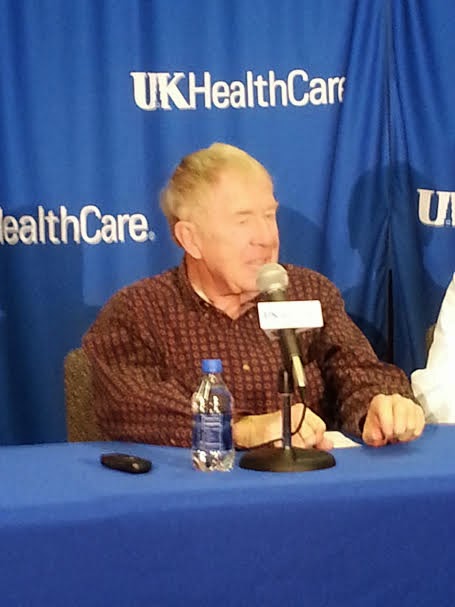
The University of Kentucky unveiled a new treatment for people with advanced symptoms of Parkinson's disease at a news conference April 21 and invited one of the first patients to participate in the clinical trial to share how this treatment has improved his function and productivity.

The new, trademarked, treatment, Duopa, provides a continuous 16 hour dose of levodopa, which is the "gold standard" drug to treat Parkinson's disease ,using a special gel preparation, is put directly into the small intestine by a portable infusion pump. It was developed by AbbVie Inc. and approved by the U.S. Food and Drug Administration in January.

"This treatment extends our ability to manage the signs and symptoms" of Parkinson's, said Dr. John Slevin, professor of neurology and vice chair of research at UK's Kentucky Neuroscience Institute. Slevin also worked with international investigators to test this treatment and is the lead author of the study, which is published in the Journal of Parkinson's Disease.

Parkinson's is a chronic and progressive disease of the nervous system that is characterized by motor symptoms such as tremors,slowness, stiffness and impaired balance and coordination. It can also cause non-motor symptoms such as sensory deficits, cognitive difficulties and sleep problems.

The cause of Parkinson's is unknown and there is no cure, but it is known that the disease process involves the death of nerve cells in the brain that produce dopamine, a chemical that sends messages to the part of the brain that controls movement and coordination.

Slevin said that there are many challenges in treating the symptoms of Parkinson's as it progresses. In addition to the continued loss of nerves in the brain, he said levodopa looses its effectiveness over time and the dose level begins to fluctuate. He also noted that over time patients will get a side-effect from the drug called dyskinesia, or involuntary muscle movement.

Another challenge, which he said prompted the development of this treatment, is that the muscles that control digestion are also affected by the disease, which creates an inconsistency in the blood level of levadopa that can be turned into dopamine in the brain.

This new treatment alleviates this challenge by placing the drug directly where it is absorbed in the intestine, allowing "The blood level, and thereby brain level (to remain) constant and that reduces the probability of having intermittent dyskinesia," Slevin said.

Marion Cox
"We are extremely pleased with the results," Slevin said in a press release. "Patients with advanced Parkinson's disease treated via this new method demonstrated marked improvement in symptom fluxuations and reduced dyskinesia."

Marion Cox, a 70-year-old Georgetown farmer and former real estate developer, who has had Parkinson's for 16 years, participated in the clinical trial for three years and said that this treatment has given him a "new lease on life."

"It was the best thing that ever happened to me. The improvements have been that great," Cox said. Later saying, "I can do anything I want to do. I can horseback ride. I've got a team of horses that I drive. I've got lots of farm equipment, excavating equipment that I drive. Before I went on the trial I was still doing those things, but unbelievably slow."

Dr. Michael Karpf, Becky Cox, Marion Cox, Dr. John Slevin
Dr. Michael Karpf, UK's vice president for health, said he was proud to be part of a major health center committed to doing clinical trials: "What UK HealthCare has to do is to not (just) practice the standards of care, we have to move the standards of care forward." Cox will be the first patient in Kentucky to receive Duopa after FDA approval.

Becky Cox, Marion's wife of 25 years, said the treatment "saved him from an early retirement." She noted that before Duopa, he had been taking an "unmanageable" number of pills to treat his symptoms, but now, after he hooks up to the pump in the morning, "It is a set it and forget it kind of thing. ... He is off and running like he always used to be, so that has been a great blessing."

Because this treatment involves an invasive procedure and because most people with Parkinson's disease respond well to oral medication initially, Slevin said this treatment is meant for those with advanced Parkinson's symptoms. He also said the cost for this treatment is still being determined, but it was already approved by Medicare. He noted that the next step will be to train other medical centers in how to deliver this treatment.

The National Parkinson Foundation website says 1 million people in the U.S. have the disease, with 50,000 and 60,000 new cases diagnosed each year. Kentucky has 14,000 people with it, Tony Bucalo, Parkinson's neuroscience account executive at AbbVie, said after the news conference.

Saturday, March 28, 2015

New health-related laws deal with heroin, dating violence, end-of-life care, prescriptions, colon-cancer and newborn screening

By Melissa Patrick
Kentucky Health News

FRANKFORT, Ky. – The Kentucky General Assembly passed several health-related bills this session, including high-profile measures on heroin and dating violence. It did not pass many others, including one that would have a great influence on the state's health: a statewide smoking ban, which passed the House for the first time ever, but never got out of an unfavorable committee in the Senate. Here's a roundup:

Heroin: Kentucky's heroin-overdose epidemic was caused partly by a 2012 legislative crackdown on prescription painkillers, which steered users to the illegal drug. Last year's bill died because of deadlock over sentences for traffickers and needle-exchange programs for addicts, and Gov. Steve Beshear and legislators gave this year's bill top priority. It was not finally negotiated until a few hours before passage, but Beshear signed Senate Bill 192 into law less than 12 hours after it passed so that its emergency clause could put it into effect immediately.

SB 192 includes both a needle-exchange program and harsher penalties against traffickers, the main points of contention between the House and Senate, but requires local governments to approve needle exchanges and allows judges to be lenient in sentencing addicts, to help them get treatment. It allocates money for drug-treatment programs, allows increased access to Naloxone, a drug that reverses the effects of an overdose, and allows jailers to provide medically assisted treatment for inmates with opiate addiction.

Dating violence: After 10 years of lobbying and debate, the dating violence bill will allow dating partners to get interpersonal protective orders from a judge if they have been the victim of dating violence, sexual abuse or stalking. This year's bill largely dissolved social conservatives' opposition by creating a new chapter in the law for dating violence, with the same protections as the domestic-violence law. Kentucky is the last state to offer protection to dating-violence victims. House Bill 8 was sponsored by Rep. John Tilley, D-Hopkinsville, who also sponsored the House heroin bill.

Beshear has signed these bills into law:

Prescription synchronization: SB 44, sponsored by Sen. Julie Raque Adams,R -Louisville, will allow patients with multiple prescriptions, in consultation with their health-care provider and their pharmacist, to synchronize prescriptions so that they may be picked up at the same time.

Medical order scope of treatment: SB 77, sponsored by Sen. Tom Buford, R-Nicholasville. will create a medical order scope of treatment (MOST) form that specifically directs the type of treatment a patient would like to have, and how much intervention he or she would like to have, during end-of-life care.

Colorectal cancer screening: SB 61, sponsored by Sen. Ralph Alvarado, R-Winchester, will require that a fecal test to screen for colon cancer, and any follow-up colonoscopy, be considered preventive measures that health insurance is required to cover without imposing additional deductible or co-insurance cost. The governor also signed a similar measure, HB 69, sponsored by Rep. Tom Burch, D-Louisville, which contains an amendment by Sen. Julian Carroll, D-Frankfort, for a Medicaid savings study.

Newborn screenings for fatal disease: SB 75, sponsored by Sen. Alice Forgy Kerr, R-Lexington, will require all newborns to be tested for Krabbe disease, a neurological disorder that destroys the protective coating of nerve and brain cells and is fatal once symptoms occur.

Spina bifida: SB 159, sponsored by Adams, will require medical providers to supply written, up-to-date, accurate information to parents when their unborn child is diagnosed with spina bifida so they can make informed decisions on treatment.

Emergency care for strokes: SB 10, sponsored by Sens. Stan Humphries, R-Cadiz, and David Givens, R-Greensburg, requires that local emergency services have access to a list of stroke-ready hospitals, comprehensive stroke centers and primary stroke centers in Kentucky. Emergency medical providers will set their own protocols for assessment, treatment and transport of stroke patients.

Alcohol and drug counselors: HB 92, sponsored by Rep. Leslie Combs, D-Pikeville, creates an enhanced licensing program to recognize three levels of certified alcohol and drug counselors, with different levels of education. The goal is to increase the number of counselors in the state.

UK cancer research centerHB 298, sponsored by Rep. Rick Rand, D-Bedford, revises the state budget to authorize $132.5 million, half of the cost, for a new medical research center at the University of Kentucky. The university says it will raise money to cover the other half.

These health bills awaited the governor's signature Monday morning:

Physician assistants: HB 258, sponsored by Rep. Denver Butler, D-Louisville, to allow physicians to supervise up to four physicians at the same time, rather than two.

In-home care: HB 144, sponsored by Burch, to establish a 60-day, hospital-to-home transition program through an approval waiver from the Department for Medicaid Services.

Pharmacist-practitioner collaboration: HB 377, sponsored by Rep. Dean Schamore, D-Hardinsburg, to allow collaboration between pharmacist and practitioners to manage patients' drug-related health needs.

Tax refund donations: SB 82, sponsored by Sen. Max Wise, R-Campbellsville, to put an income tax check-off box on tax forms to allow people the option of donating a portion of their tax refund to support pediatric cancer research, rape crisis centers or the Special Olympics.

Health related bills that were left hanging:

The smoking ban, HB 145, sponsored by Rep. Susan Westrom, D-Lexington, never got a hearing in the Senate Veterans, Military Affairs and Public Protection Committee, and neither did the Senate companion bill, SB 189, sponsored by Adams.

Three bills challenged Medicaid managed-care companies. SB 120, sponsored by Alvarado, would have created a process for health-care providers to appeal the companies' decisions to the state passed the Senate, but not the House.  And the following two bills that never got out of the Senate: SB 88, also sponsored by Alvarado, which challenged the $50 "triage fees" MCOs pay for emergency-room visits that they conclude were not emergencies, and would have required them to pay contracted fees instead and SB 31, sponsored by Buford, which would limited the amount of co-payments. Also not getting House action was Alvarado's SB 6 would have created review panels for lawsuits seeking damages from health-care providers.

Wednesday, March 25, 2015

Heroin bill finally passes and is signed into law; Naloxone program put into motion; dating-violence bill sent to Beshear

By Melissa Patrick
Kentucky Health News

The long-negotiated bill to tackle Kentucky's heroin-overdose epidemic passed in the final hours of the 2015 legislative session.

Almost immediately after the heroin bill passed the Senate, a bill to offer immediate civil protections to dating partners who are victims of dating violence was passed after being held in the chamber since February 13 -- likely because Democratic Rep. John Tilley of Hopkinsville, chair of the House Judiciary Committee, was the original sponsor of both bills.

Tilley told reporters that the passage of the two bills meant it had been a successful session.

Gov. Steve Beshear signed the heroin legislation, Senate Bill 192, into law Wednesday, March 25, less than 12 hours after it passed, so that its emergency clause could put it into effect immediately. The dating violence bill, House Bill 8, has been delivered for his signature.

"Senate Bill 192 is tough on traffickers who bring these deadly drugs into our communities, but compassionate toward those who report overdoses or who admit they need help for their addiction," Beshear said in a release. "I applaud our legislators for putting aside partisan interests for the greater good of all Kentuckians who have been affected by this devastating drug."

The bill passed the Democrat-controlled House 100-0 and the Republican-controlled Senate 34-4. Republican senators John Schickel of Union, Joe Bowen of Owensboro, Chris Girdler of Somerset and Paul Hornback of Shelbyville voted against it.

The stickiest issues were a needle-exchange program, which many senators opposed, and tough new penalties for drug traffickers, which Tilley and many House members said would not be effective. The new law allows needle-exchange programs of approved by local governments, and the tough penalties, but allows the judge to be lenient in sentencing if the defendant is an addict.

The bill also allocates money for drug treatment programs; includes a "good Samaritan" provision that allows a person to seek medical help for an overdose victim and stay with them without fear of being charged; access for addicts and their families to the drug Naloxone, a drug that reverses the effects of an overdose; and allows the Department of Corrections to provide an approved medication to inmates to prevent a relapse in their addiction.

"The bill includes provisions that are important to law enforcement and me: increasing penalties for large volume traffickers, expanding access to treatment, and getting heroin overdose reversal kits into the hands of our first responders. I know this legislation will save lives," Attorney General Jack Conway said in a news release.

Hornback argued that "forced rehab doesn't usually work," providing addicts with Naloxone and free needles simply enables them and the bill does not allow addicts any "consequences for their actions."

He said that while he knows there are people dying from heroin overdoses,"I didn't make that decision for them and I for one, and a lot of my constituents are tired of paying for people's bad decisions and that is what this (bill) does."

Tilley said in an interview after the vote that needle exchange programs are proven to work, will save taxpayers money and are absolutely necessary to "stem the tide of two tidal-waves that are headed Kentucky's way: HIV and Hepatitis C and Hepatitis B."

"The cost of treating someone with HIV is $350,000. The cost of treating someone with Hepatitis C is $85,000. The budget now had a $55 million hit just with the explosion of Hepatitis C last year. We can't afford that in Kentucky," he said. Advocates say the programs can be a gateway to treatment and rehabilitation.

Meanwhile, Conway and first lady Jane Beshear announced that funding for Naloxone kits would be made available to the hospitals in Kentucky with the highest rates of heroin overdose deaths. The kits will be provided free to every treated and discharged overdose victim at the pilot-project hospitals.

They made the announcement at the University of Louisville, which treated 588 people in 2013 for heroin overdoses, a news release said. In 2013, the latest data available, 230 of the 722 autopsied overdose deaths, or 32 percent, were caused by heroin, according to the Kentucky Office of Drug Control Policy.

Tilley and Republican Sen. Whitney Westerfield, also of Hopkinsville, "forged a friendship that allowed the two men to work out differences on a pair of high profile bills fraught with political pitfalls," Adam Beam reports for The Associated Press. "Westerfield, a former prosecutor, is running for attorney general against the son of Democratic Gov. Steve Beshear, giving Democrats all the reason in the world not to work with him."

The AP notes that Republican Sen. Chris McDaniel wrote the first draft of the heroin bill that passed the Senate in January, but it omits McDaniel's other role: candidate for lieutenant governor on a slate headed by Agriculture Commissioner James Comer. As the Senate prepared to give the final bill final passage, Republican Floor Leader Damon Thayer accused the House of not passing McDaniel's bill because of his candidacy.
Read more here: http://www.kentucky.com/2015/03/25/3767938_political-compromises-brokered.html?rh=1#storylink=cpy

Sunday, October 26, 2014

KET will look at how Kentucky communities are fighting back against the heroin epidemic

Heroin use is sky-rocketing in certain areas of Kentucky and many communities are fighting back with local solutions.

Host Renee Shaw and guest will share how communities are coming together to save lives, expand treatment options and prevent others from becoming addicted on the next episode of KET's "HealthThree60" program Monday, Oct. 27 at 9 p.m. ET; and Wednesday, Oct. 29 at 3 p.m ET.

KETKY will air the show on Wednesday, Oct. 29, at 3 p.m.; Thursday, Oct. 30, at 11 p.m.; and Friday, Oct. 31, at 9 a.m. All times are Eastern.

Thursday, August 7, 2014

UK professor develops nasal spray to deliver standard antidote to painkiller overdose; fast-tracked, in final clinical trials

A new lifesaving product to treat painkiller overdoses is in its final round of clinical trials at the University of Kentucky and is being fast-tracked by the U.S. Food and Drug Administration.

The product is a nasal-spray application of the anti-opoid drug naloxone, developed by Daniel Wermeling, professor in the UK College of Pharmacy, through his startup company AntiOp Inc.

Opioids are the class of pain-killing drugs that are related to morphine, including prescription drugs such as hydrocodone and oxycodone as well as illegal drugs such as heroin. Naloxone is the the standard treatment for suspected opioid overdose, according to a UK news release.

Naloxone is now administered by injection. The spray eliminates the need for needles, with a ready-to-use, single-use delivery device inserted into the nose of an overdose victim. The product delivers a consistent dose, absorbed across the nasal membranes even if the patient is not breathing.

"The goal is to make the medication available to patients at high risk of opioid overdose and to caregivers, including family members, who may lack specialized medical training," Wermeling said. "The treatment could be given in anticipation of EMS arrival, advancing the continuum of care and ultimately saving lives."

Nationwide, deaths from opioid overdose are on the rise, according to the federal Centers for Disease Control and Prevention. Kentucky, with a long history of opoid abuse, ranks third in the nation for drug overdoses, with more than 1,000 dying each year. Heroin abuse is on the rise, with 230 deaths, or 31.9 percent, of autopsied overdose deaths attributed to heroin in 2013.  This is a 60 percent increase from the previous year, according to the Kentucky Office of Drug Control Policy.

Congratulating Wermeling on his success, UK President Eli Capilouto said, "The epidemic of opioid abuse in our state presents an enormous and urgent challenge, not only for health care providers and law enforcement but also for us here at the University of Kentucky. Dr. Wermeling's project is putting a powerful new tool into the hands of those on the front line of the fight against heroin, both here in Kentucky and beyond."

Wermeling's research was supported by a three-year, $3 million grant from the National Institutes of Health through the National Institute on Drug Abuse with additional funding from the Kentucky Science and Technology Corporation. His company partnered with Reckitt Benckiser Pharmaceuticals in May to accelerate the production and worldwide marketing of the product.