Showing posts with label drugs. Show all posts

Thursday, July 2, 2015

McConnell, Mass. Democrats find common ground on opioid-overdose epidemic; Kentucky ranks 3rd in overdose deaths

Republican U.S. Sen. Mitch McConnell and two Massachusetts Democrats have found common ground in efforts to fight the opioid-overdose crisis and are working across the aisle to push for legislation and information to address it, Asma Khalid reports for WBUR, a Boston NPR affiliate.

Sens. Ed Markey, D-Mass., and Mitch McConnell, R-Ky.,
agree on fighting 
the opoid overdose epidemic. (AP photos)
“McConnell and I are requesting that there be a surgeon general report on the opioid overdose epidemic in the United States,” Sen. Ed Markey told Khalid. Markey is also co-sponsoring a bill with Sen. Rand Paul, R-Ky., to expand the use of medication-assisted treatment, like Suboxone.

Kentucky has the third highest overdose death rate in the nation, with more than 1,000 people dying each year, according to the state attorney general's website. Massachusetts has the 32nd highest overdose death rate in the nation, according to Trust for America's Health. Most of these opioid deaths in both states are from prescription drugs.

“The reason I can do that with two senators from Kentucky, who are Republicans, is that there really is no difference between Lexington, Massachusetts, and Lexington, Kentucky,” Markey said. “We have an epidemic in both states, and we have to ensure that we put together a national plan.”

McConnell has also partnered with Rep. Katerine Clark, D-Mass,, on a bill that focuses on infants and neonatal abstinence syndrome. “Mitch McConnell and I may disagree on 98 percent of topics, but we agree on this,” Clark told Khalid.

Drug-dependent newborns in Kentucky increased by 48 percent last year, to 1,409 from 955 in 2013, which was up from only 28 in 2000, Laura Ungar reported for The Courier-Journal last week. "Research in the Journal of Perinatology shows opioid addiction in babies grew nearly five-fold between 2000 and 2012," Khalid notes.

The McConnell-Clark proposal "tries to pull the best practices from around the country to improve treatment and prevention for sick babies. The bill has 80 cosponsors so far, and they’re from both sides of the aisle," Khalid reports, with no opposition voiced at the House Committee Energy and Commerce last week.

Another Massachusetts Democrat on the committee said he supports the effort, but the key is money -- something McConnell has been stingy with, supporting automatic cuts to reduce the federal budget deficit.

“The big push that I’ve been trying to focus on in our hearings is this comes back to the lack of resources — lack of doctors, lack of treatment facilities, lack of beds, lack of continuum of care,” said Rep. Joe Kennedy III, D-Mass., “because our federal government has systematically underfunded resources for prevention and treatment.”

Friday, June 26, 2015

Half again as many Kentucky newborns were hospitalized for drug dependency last year as the year before

Mother Samantha Adams and her newborn Leopoldo Bautista,
10 days old, spend quality time inside the Louisville Norton
Healthcare
child care center for children experiencing drug
withdrawal. (Photo by Alton Strupp, The Courier-Journal)
Increasing drug abuse drove up hospitalizations of drug-dependent newborns in Kentucky by 48 percent last year, to 1,409 from 955 in 2013. "The latest numbers represent a 50-fold increase from only 28 hospitalizations in 2000," reports Laura Ungar of The Courier-Journal.

"The seemingly never-ending increase every year is so frustrating to see," Van Ingram, executive director of the state Office of Drug Control Policy, told Ungar. "It's a horrible thing to spend the first days of your life in agony."

"These infants are born into suffering," Ungar writes. "They cry piercingly and often. They suffer vomiting, diarrhea, feeding difficulties, low-grade fevers, seizures — and even respiratory distress if they're born prematurely."

Drug-dependent newborns are becoming more common nationwide, Ungar notes, but "Vanderbilt University researchers publishing in the Journal of Perinatology [a subspecialty of obstetrics concerned with the care of the fetus and complicated, high-risk pregnancies] say rates are highest in a region encompassing Tennessee, Mississippi, Alabama and Kentucky."

While the increase is blamed mostly on illegal drug use, the Vanderbilt study found that 28 percent of pregnant Medicaid recipients in Tennessee filled at least one painkiller prescription, Ungar writes: "Legitimate use not only raises the risk of having a drug-dependent baby, it can sometimes lead to abuse and addiction."

While Medicaid now pays for behavioral-health and substance-abuse treatment, "Drug treatment for pregnant women is sorely lacking," Ungar reports. In Kentucky, only 71 of the 286 treatment facilities listed by the U.S. Substance Abuse and Mental Health Services Administration treat pregnant women. 

Sunday, June 21, 2015

Kentucky is cracking down on Suboxone, a heroin substitute that has become a big part of the illegal trade in painkillers

A drug that was supposed to help people get off heroin has "created a new cash-for-pills market and a street trade" that state officials are trying to stop, Mary Meehan reports for the Lexington Herald-Leader.

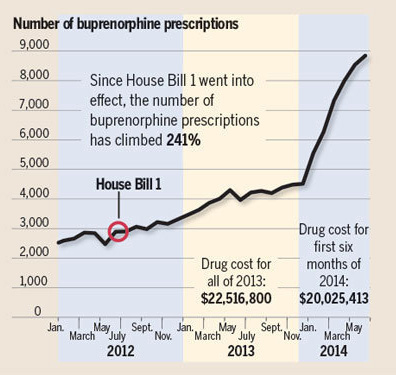
The drug is buprenorphine, the active ingredient in the brand-name drugs Suboxone and Subutex, which became more popular in 2012, when the state cracked down on "pill mills" that were freely handing out prescriptions for painkillers. "A lot of the pill mills morphed into facilities that dispense these prescriptions," Dr. John Langefeld, medical director for the state's Medicaid program, told Meehan.

Also, Meehan writes, the Patient Protection and Affordable Care Act required insurance plans to cover treatment for substance abuse, and "as more Medicaid patients and others got health-insurance coverage, more people obtained prescriptions for buprenorphine, Langefeld said. . . . According to a state report, one user obtained prescriptions from nine doctors."
Read more here: http://www.kentucky.com/2015/06/20/3910362_the-drug-that-was-supposed-to.html?rh=1#storylink=cpy

Lexington Herald-Leader chart by Chris Ware from state data
Use of the drug in Kentucky "has increased 241 percent since 2012," Meehan reports. "And 80 percent of the prescriptions for it were being written by 20 percent of the state's 470 certified prescribers, said Dr. Allen Brenzel, medical director of the state's Department of Behavioral Health. . . . Since 2011, 10 doctors have been sanctioned by the Kentucky Board of Medical Licensure because of problems prescribing Suboxone."

Suboxone is supposed to be taken in conjunction with therapy and drug testing. "a patient receives a controlled dose of a legal drug as the dose is tapered by a physician for a safe and effective withdrawal," Meehan notes. However, "doctors started to see Suboxone patients on a cash basis, asking for as much as $300 for an office visit that included a prescription for the maximum allowable amount of Suboxone. Patients often received no therapy or drug testing. Some patients were on the maximum dose indefinitely, Brenzel said." Some doctors prescribed the drug with other painkillers, creating an illegal market.

To prevent such abuse by unscrupulous doctors, the medical-licensure board has issued regulations that require "more physician education and the requirement that the drug be prescribed only for medically supervised withdrawal and not be given to pregnant women," Meehan writes. "Patients should also be closely monitored and drug tested. If those rules are not followed, a doctor can face sanctions or restrictions to his medical license."

Suboxone was in the national news recently because the accused killer in the Charleston, S.C., shootings was arrested for illegal possession of it four months ago at a South Carolina shopping mall, the Herald-Leader notes.
Read more here: http://www.kentucky.com/2015/06/20/3910362_the-drug-that-was-supposed-to.html?rh=1#storylink=cpy

Read more here: http://www.kentucky.com/2015/06/20/3910362_the-drug-that-was-supposed-to.html?rh=1#storylink=cpy

Saturday, June 20, 2015

Biotech firm buys UK professor's anti-overdose nasal spray

Pharmacy Professor Daniel Wermeling at the University of Kentucky invented a nasal spray to fight heroin overdoses, and a biotech firm has bought the product, which may be on the market within six months, pending approval by the U.S. Food and Drug Administration. The device "contains a single dose of a mist form of naloxone and delivers the drug in a way similar to how Flonase is used to treat allergies," Mary Meehan reports for the Lexington Herald-Leader.

The product is on a fast track for approval because of the rising rates of heroin overdoses across the country, said UK Provost Tim Tracy, former dean of UK's pharmacy school. Wermeling doesn't know exactly when his product will be on the market, but he said the FDA approved another fast-track, anti-overdose therapy after only 14 weeks. The fast-track program speeds development of drugs to treat serious or life-threatening conditions. "Last year, 233 people [in Kentucky] died with heroin in their systems, according to the state medical examiner's office," Meehan notes.

Wermeling has been developing the project at UK since 2009 with the help of more than $5 million in federal and state tax dollars. Tracy said Indivior PLC, the spinoff pharmaceutical company that bought the nasal spray, will be able to manufacture, market and distribute the product. Right now, emergency responders and hospitals must draw naloxone, branded as Narcan, in a syringe to provide the correct dose.

Three doctors, nine others in western half of Kentucky are indicted in the largest-ever federal 'takedown' of Medicaid fraud

Former Dr. Fred Gott of Bowling Green was arrested.
(Photo: Miranda Pederson, Bowling Green Daily News)
Twelve people in the western half of Kentucky, including three doctors, have been charged with Medicaid fraud in what the federal government calls its biggest-ever "takedown" of the problem, Andrew Wolfson of The Courier-Journal reports.

The indictments allege "a half-dozen schemes involving nearly $8 million in alleged fraudulent billings," Wolfson writes. "The offenses include $5 million in false billings for muscle-relaxant injections that were never delivered to patients, as well as a staged car wreck in which three people allegedly conspired to get controlled substances and fraudulent reimbursements."

In another case, Wolfson reports, "a medical practice that treated car wreck patients is accused of using the DEA numbers of nurse practitioners to order hydrocodone for herself and falsely billing it to an insurance company. Nationally, the sweep resulted in charges against 243 people, including 46 doctors, nurses and other licensed medical professionals."

John Kuhn, acting U.S. attorney for the Western District of Kentucky, told Wolfson that about $1 billion of annual Medicare and Medicaid expenses are fraudulent. Medicare is the federal health-insurance program for people over 65; Medicaid is the federal-state program for the poor and disabled.

Former Dr. Fred Gott of Bowling Green, a 63-year-old cardiologist, was charged with "conspiracy to dispense controlled substances, health care fraud and money laundering," Deborah Highland reports for the Bowling Green Daily News. "The Bowling Green-Warren County Drug Task Force opened an investigation into Gott’s practices after Warren County Coroner Kevin Kirby alerted the task force about drug overdose deaths involving Gott’s patients, task force director Tommy Loving said."

Sunday, May 24, 2015

Louisville's PharMerica is still a defendant in federal cases in which big drug makers have paid billions in fines

Abbott Laboratories has paid billions, and Amgen Inc. has paid millions, in fines for offering "rebates" or "kickbacks" to get pharmacy companies to increase their prescriptions of drugs in nursing homes, and PharMerica Corp. of Louisville is the remaining defendant in both civil cases, according to a detailed report by James McNair at the Kentucky Center for Investigative Reporting.

PharMerica manages drug benefits for nursing homes, hospitals and assisted living facilities. McNair paints a dismal picture of nursing homes and says they are ripe for this type of abuse, writing that they house "people with age-weakened bodies, multiple ailments and, often, severe mental impairment. Many are over-medicated. Many have no visitors. A third of them will die within a year of admission." (Click on chart for larger version)


McNair notes that a whistleblower lawsuit first called attention to Abbott Labs, which pled guilty in 2012 to a criminal charge, settled civil kickback and fraud claims, and paid $1.5 billion in fines for its role in paying millions of dollars in "rebates" to get pharmacy companies to increase prescriptions for an anti-seizure drug, Depakote, for uses beyond its Food and Drug Administration approval. Medicaid payments for this drug "went on to top $7 billion," McNair reports.

Amgen also enlisted these same pharmacy companies to promote its anemia drug, Aranesp, for uses beyond its FDA approval, and after pleading guilty settled civil kickback and fraud charges and paid a total of $762 million in fines.

These two cases brought more government attention to such schemes, which are "standard practice in the pharmaceutical industry," and also on the pharmacy companies that are on the receiving end of the payoffs, McNair writes.

McNair describes PharMerica as the "second-biggest operator of nursing home pharmacies in the country" and writes that it had " $1.9 billion in revenue last year," making it the "10th-biggest publicly traded company in Kentucky, according to rankings by The Lane Report." Since 2007, the chief executive has been Gregory Weishar (pronounced WISH-er) .

Companies like PharMerica, and its larger competitor Cincinnati-based Omnicare Inc., act on behalf of the nursing homes, buying drugs from the pharmaceutical companies in bulk and then dispensing them under the supervision of "consultant pharmacisits," McNair reports.

The Abbott Labs and Amgen lawsuits assert that PharMerica gave "certain drugs to nursing home patients in return for drug company kickbacks, not because they were the "right medication."" McNair reports that the suits were filed by drug company insiders who have knowledge of these payoffs disguised as "rebates" or "discounts."

"PharMerica denies the claims," writes McNair. But the company has been in this type of case many times since 2005, McNair reports: It has agreed to pay $40 million in fines to settle federal complaints, five additional closed cases connected to this company.

McNair also reports that just last week, the Justice Department said PharMerica will pay $31.5 million for dispensing addictive painkillers to nursing home patients without prescriptions, then falsely billing Medicare. As part of this settlement, PharMerica also agreed to a five year "corporate integrity agreement," which McNair notes later in the article are rarely enforced.

McNair goes on to list the details of several other cases PharMerica has been involved in, one of them "deemed so flagrant that the inspector general sought to ban PharMerica from federal health-care programs for 10 years."

PharMerica declined to make its executives available for an interview with the Kentucky Center for Investigative Reporting but said in a statement: “PharMerica is committed to outstanding compliance and the highest standards of ethical conduct, and we are diligent in ensuring that we comply with all applicable law and regulation,”

Jan Scherrer, vice president of Kentuckians for Nursing Home Reform, a non-profit advocacy group based in Lexington, told McNair that the CEOs of companies involved in kickback schemes should be held personally accountable, "These are not victimless crimes," he said.

“It’s the same players -- PharMerica and Omnicare,” Scherrer continued. “They keep doing this over and over and over, and all they get is a fine. And for them that fine is nothing more than the cost of doing business.” (Read more of this detailed report by clicking here.)

State health commissioner backs needle exchanges, most controversial part of anti-heroin legislation passed this year

The Kentucky General Assembly cracked down in 2012 on "pill mills" that dispense painkillers irresponsibly, and addicts responded by going for heroin, creating a big problem in much of the state. The 2015 legislature passed laws to crack down on heroin, including local needle-exchange programs, the most controversial feature of the package.

In a column distributed to Kentucky newspapers, state Health Commissioner Stephanie Mayfield defends and promotes the local programs, which are subject to local approval.

“To some, a needle exchange may sound like a program that helps intravenous drug users feed their habit,” Mayfield writes. “To the contrary, the intent of an NEP is to protect public health and create a path for heroin users to get treatment while preventing the spread of diseases through the sharing of needles.

Needle exchanges reduce the number of HIV/AIDS and hepatitis cases in a community, Mayfield writes. "The use or even the accidental stick of a dirty needle can lead to hepatitis, HIV/AIDS infection and other dangerous diseases. . . . About 15 percent of all HIV cases that have occurred in Kentucky have been among injecting drug users."

Stephanie M. Gibson
Mayfield also says needle exchanges protecting people from accidental sticks from dirty needles discarded in public places. "Intravenous drug users submit dirty needles to the NEP for proper disposal in exchange for clean needles," she writes. "Researchers have also found that injecting drug users who participated in an exchange were more likely to reduce or stop injecting than drug users who had not participated in a needle exchange."

Research has also shown that needle exchanges "do not encourage the initiation of drug use nor do they increase the frequency of drug use among current users," Mayfield writes, noting that there are 203 such programs in 34 states.

"The presence of NEPs in communities does not expand drug-related networks nor does it increase crime rates. . . . Needle exchange programs actually create a path for injecting drug users to get help because the programs offer information on how to find available treatment options. In fact, NEP participants are more likely to enter a drug treatment program than nonparticipants."

More recent studies show that needle exchanges "provide opportunities for disease testing and education leading to a decline of at-risk behaviors, resulting in HIV incidence dropping as much as 80 percent within this population," Mayfield writes. "Many Kentucky communities are desperate for the ability to reach out to members who suffer from addiction, to help slow the spread of diseases and provide treatment referrals to people they might otherwise never have the chance to reach. This law gives them that opportunity."

Monday, May 11, 2015

Kentucky led the nation in hepatitis C cases in 2013; state's rate rose 357 percent from 2007 to 2011

By Tim Mandell
Kentucky Health News

Kentucky had the nation's highest rate of hepatitis C in 2013, with 5.1 cases per every 100,000 people, says a report by the federal Centers for Disease Control and Prevention. As many as 3.5 million people in the U.S. have hepatitis C and more than 56,000 Kentucky resident may have chronic hepatitis C infection, according to the state Cabinet for Health and Family Services. The main cause of hepatitis C is shared needles among intravenous drug users.

Hepatitis C cases rose 364 percent in Kentucky, Tennessee, Virginia and West Virginia from 2006 to 2012. The big increase was in 2007-11, when the rate rose 357 percent, a CDC state health profile says.

"Of the cases that have been reported and researchers gathered data about potential risk factors, 73.1 percent reported injecting drugs," Brian Wu reports for Science Times. Among new cases, 44.8 percent were people under 30.

While officials said HIV rates are low in the four Appalachian states, they said they fear that the increase in hepatitis C cases could lead to a rise in HIV cases, Wu writes. Officials said needle-exchange programs are key to reduce the number of potential HIV cases. Kentucky recently authorized such programs if local officials agree to them.

"About 4.5 million Americans older than 12 abused prescription painkillers in 2013 and 289,000 used heroin, according to the Substance Abuse and Mental Health Services Administration," Liz Szabo reports for USA Today. "About 75 percent of new heroin users previously abused opioid painkillers. The number of first-time heroin users grew from 90,000 people in 2006 to 156,000 in 2012, according to the CDC."

Kentucky has the third highest drug overdose mortality rate in the U.S., with 23.6 deaths per 100,000 people, says the 2013 report "Prescription Drug Abuse: Strategies to Stop the Epidemic," reports Trust for America's Health. "The number of drug overdose deaths—a majority of which are from prescription drugs—in Kentucky quadrupled since 1999 when the rate was 4.9 per 100,000."

Tuesday, April 14, 2015

Pain and fever reducer acetaminophen, most-used drug in U.S., is found to reduce positive emotions and reduce psychological pain

Ohio State University researchers discovered a new side effect of acetaminophen, a leading over-the-counter pain reliever: it also blunts positive emotions. Other research revealed that it helps reduce psychological pain. The drug has been used in the U.S. for more than 70 years and is best known by the brand name Tylenol.

In the Ohio study, participants took Tylenol or a placebo, then looked at very pleasant or very disturbing photos. Those in the experimental group reported weaker emotions than those in the control group. On average, those who took the placebo rated their level of emotion when viewing the photos at 6.76 on a scale of 10, while people who took the pain reliever averaged 5.85.

"Rather than just being a pain reliever, acetaminophen can be seen as an all-purpose emotion reliever," said Geoffrey Durso, the lead author of the study and a doctoral student in social psychology.

Balwin Way, an assistant psychology professor who conducted the study with Durso, said those who took Tylenol didn't seem to be aware they were reacting differently. "Most people probably aren't aware of how their emotions may be impacted when they take acetaminophen," he said.

Acetaminophen, found in more than 600 medicines, is the most common drug in the U.S., according to the Consumer Healthcare Products Association. Every week approximately 52 million American adults, 23 percent of the population, use a medicine with acetaminophen in it. Durso said researchers don't know if other pain relievers like ibuprofen and aspirin have similar effects, but they plan to study that question.

Thursday, April 2, 2015

Polling shows Kentucky ranks third in share of residents, 24.5 percent, who say they take mood-altering drugs every day

Kentucky is the place to be for mood-altering drugs. The state ranked third in a Gallup Organization study that asked 450 adults in each state how often they use drugs and medications to affect their mood or relax them, Christopher Ingraham reports for The Washington Post. West Virginia led, with 28.1 percent of respondents saying they use mood-altering drugs every day, Rhode Island was second at 25.9 percent, but Kentucky was not far behind at 24.5 percent.

Nationally, 18.9 percent of respondents said they take drugs almost every day, while 62.2 percent said they never do, 13.1 percent said they rarely do and 5 percent said they sometimes do.

The way the question was worded allows for errors, Ingraham writes. The question asked about drugs and medications, but didn't specify which ones, and didn't mention alcohol or tobacco. That left interpretation of the question up to individual respondents.

A recent National Survey of Drug Use and Health said that at least 71 percent of American adults drank in the past year, and 56 percent drank in the past month, which if true, could raise the rates in most states, if respondents were to consider alcohol a mood-altering drug. (Read more) (To view this interactive Post map click here)

Wednesday, March 25, 2015

Heroin bill finally passes and is signed into law; Naloxone program put into motion; dating-violence bill sent to Beshear

By Melissa Patrick
Kentucky Health News

The long-negotiated bill to tackle Kentucky's heroin-overdose epidemic passed in the final hours of the 2015 legislative session.

Almost immediately after the heroin bill passed the Senate, a bill to offer immediate civil protections to dating partners who are victims of dating violence was passed after being held in the chamber since February 13 -- likely because Democratic Rep. John Tilley of Hopkinsville, chair of the House Judiciary Committee, was the original sponsor of both bills.

Tilley told reporters that the passage of the two bills meant it had been a successful session.

Gov. Steve Beshear signed the heroin legislation, Senate Bill 192, into law Wednesday, March 25, less than 12 hours after it passed, so that its emergency clause could put it into effect immediately. The dating violence bill, House Bill 8, has been delivered for his signature.

"Senate Bill 192 is tough on traffickers who bring these deadly drugs into our communities, but compassionate toward those who report overdoses or who admit they need help for their addiction," Beshear said in a release. "I applaud our legislators for putting aside partisan interests for the greater good of all Kentuckians who have been affected by this devastating drug."

The bill passed the Democrat-controlled House 100-0 and the Republican-controlled Senate 34-4. Republican senators John Schickel of Union, Joe Bowen of Owensboro, Chris Girdler of Somerset and Paul Hornback of Shelbyville voted against it.

The stickiest issues were a needle-exchange program, which many senators opposed, and tough new penalties for drug traffickers, which Tilley and many House members said would not be effective. The new law allows needle-exchange programs of approved by local governments, and the tough penalties, but allows the judge to be lenient in sentencing if the defendant is an addict.

The bill also allocates money for drug treatment programs; includes a "good Samaritan" provision that allows a person to seek medical help for an overdose victim and stay with them without fear of being charged; access for addicts and their families to the drug Naloxone, a drug that reverses the effects of an overdose; and allows the Department of Corrections to provide an approved medication to inmates to prevent a relapse in their addiction.

"The bill includes provisions that are important to law enforcement and me: increasing penalties for large volume traffickers, expanding access to treatment, and getting heroin overdose reversal kits into the hands of our first responders. I know this legislation will save lives," Attorney General Jack Conway said in a news release.

Hornback argued that "forced rehab doesn't usually work," providing addicts with Naloxone and free needles simply enables them and the bill does not allow addicts any "consequences for their actions."

He said that while he knows there are people dying from heroin overdoses,"I didn't make that decision for them and I for one, and a lot of my constituents are tired of paying for people's bad decisions and that is what this (bill) does."

Tilley said in an interview after the vote that needle exchange programs are proven to work, will save taxpayers money and are absolutely necessary to "stem the tide of two tidal-waves that are headed Kentucky's way: HIV and Hepatitis C and Hepatitis B."

"The cost of treating someone with HIV is $350,000. The cost of treating someone with Hepatitis C is $85,000. The budget now had a $55 million hit just with the explosion of Hepatitis C last year. We can't afford that in Kentucky," he said. Advocates say the programs can be a gateway to treatment and rehabilitation.

Meanwhile, Conway and first lady Jane Beshear announced that funding for Naloxone kits would be made available to the hospitals in Kentucky with the highest rates of heroin overdose deaths. The kits will be provided free to every treated and discharged overdose victim at the pilot-project hospitals.

They made the announcement at the University of Louisville, which treated 588 people in 2013 for heroin overdoses, a news release said. In 2013, the latest data available, 230 of the 722 autopsied overdose deaths, or 32 percent, were caused by heroin, according to the Kentucky Office of Drug Control Policy.

Tilley and Republican Sen. Whitney Westerfield, also of Hopkinsville, "forged a friendship that allowed the two men to work out differences on a pair of high profile bills fraught with political pitfalls," Adam Beam reports for The Associated Press. "Westerfield, a former prosecutor, is running for attorney general against the son of Democratic Gov. Steve Beshear, giving Democrats all the reason in the world not to work with him."

The AP notes that Republican Sen. Chris McDaniel wrote the first draft of the heroin bill that passed the Senate in January, but it omits McDaniel's other role: candidate for lieutenant governor on a slate headed by Agriculture Commissioner James Comer. As the Senate prepared to give the final bill final passage, Republican Floor Leader Damon Thayer accused the House of not passing McDaniel's bill because of his candidacy.
Read more here: http://www.kentucky.com/2015/03/25/3767938_political-compromises-brokered.html?rh=1#storylink=cpy

Sunday, January 11, 2015

New marijuana product called 'wax' often smoked in e-cigarettes

A new marijuana product on the market called Wax (also called Butter and Honeycomb) that is easily disguised and used in e-cigarettes has found its way to Kentucky, Erica Coghill reports for WLKY-TV in Louisville.

It is called "wax" because its yellow color and waxy texture makes it look like earwax, and that makes it easy to conceal because it looks and feels like lip balm, Raychelle Cassada Lohmann writes for Psychology Today.

"Wax" is made from the oils of marijuana plants and has a high level of THC, the ingredient in marijuana that makes a user high, and while it is easy to make, the ingredients are "highly flammable and dangerous," Lohmann reports.

"What they do is they take marijuana, then take the THC out of it, put it in wax form, stick it in an e-cig, which heats it up, melts it, and you smoke it just like an e-cig, but you get the high off the marijuana," Tim Gividen, Carrollton police officer told Coghill.

"Wax" is much stronger than marijuana,. and can be eaten or smoked. "What's super-scary is that this new substance is equal to smoking 15 to 20 joints and can give a buzz that may last a full day," Lohmann reports.

E-cigarettes are composed of water vapor, flavoring and nicotine.  "You're not going to get the marijuana smell off the smoke, because it is going to be disguised with flavoring, "Gividen told Coghill. Heroin is also being smoked with e-cigs, Coghill said.

Gividen, who patrols schools in Carroll County, learned about "wax" when he confiscated an e-cigarette from a student at Carroll County High School and started asking questions. He found out that it had been popular on the West Coast, but had worked its way across the country.

"Actually, in Trimble County, it has been an issue within their high school, so we know it is something that is surrounding us and a problem," Hayley Franklin, director of Champions For A Drug Free Carroll County, told Coghill.

Gividen and Franklin reminded parents to "keep an eye on their kids and who they're hanging out with, and educate them about the dangers of drugs."

Lohmann suggests that parents keep an eye out for items used in the making of "wax": butane containers, glass/metal tubes, glass baking dishes, isopropyl alcohol and coffee filters.

Tuesday, September 23, 2014

Kentucky doctors treat an increasing number of babies suffering from drug addiction given to them by their mothers

Neonatal abstinence syndrome, or NAS, is becoming such a widespread problem that many medical professionals are calling it an epidemic and a public-health crisis. In 2001, 67 Kentucky babies were hospitalized for drug withdrawal, and in 2013, 955 were, according to the Cabinet for Health and Family Services, Justin Madden writes for The Lexington Herald-Leader.

Baby Sheena, who has neonatal abstinence syndrome, in
treatment at the University of Kentucky Children's Hospital.
(Lexington Herald-Leader photo by Mark Cornelison)
Henrietta Bada, a neonatologist at the University of Kentucky Children's Hospital, said babies born with NAS are eager to eat, "but then you give them their formula or their feedings, but they just cannot." She said they can't "coordinate their suck-swallow reflexes . . . If they are not treated, then they end up with weight loss, dehydration," and are sicker than if they had only been going through withdrawal.

Bada said she can treat the babies with medication, but she wants to make sure they go to a safe home: "Babies have to go home to a mother that is capable of taking care of him or her." There isn't enough care for mothers dealing with drug addictions, she said, "and the lack of care continues after the baby is born." She also noted that at least 80 percent of the medical bills are paid through Medicaid, "which can cost as much as $60,000."

The Kentucky Perinatal Association and the state's Department for Public Health are working together to make standardized treatments for mothers and babies, The Associated Press reported earlier this month. Officials also continue to look for ways to solve the state's drug problem.

Eric Reynolds, a neonatologist at Kosair Children's Hospital in Louisville, pointed out that NAS isn't always a result of a mother abusing drugs. "We need better treatment options for the pregnant mothers who have a legitimate medical reason to be on these types of medications," he said.

Reynolds and Bada said endeavors to fight NAS begin with education, and Reynolds added that the long term effects of NAS are not yet known because it's early in the epidemic, Madden writes.