Showing posts with label doctors. Show all posts

Sunday, June 21, 2015

Kentucky is cracking down on Suboxone, a heroin substitute that has become a big part of the illegal trade in painkillers

A drug that was supposed to help people get off heroin has "created a new cash-for-pills market and a street trade" that state officials are trying to stop, Mary Meehan reports for the Lexington Herald-Leader.

The drug is buprenorphine, the active ingredient in the brand-name drugs Suboxone and Subutex, which became more popular in 2012, when the state cracked down on "pill mills" that were freely handing out prescriptions for painkillers. "A lot of the pill mills morphed into facilities that dispense these prescriptions," Dr. John Langefeld, medical director for the state's Medicaid program, told Meehan.

Also, Meehan writes, the Patient Protection and Affordable Care Act required insurance plans to cover treatment for substance abuse, and "as more Medicaid patients and others got health-insurance coverage, more people obtained prescriptions for buprenorphine, Langefeld said. . . . According to a state report, one user obtained prescriptions from nine doctors."
Read more here: http://www.kentucky.com/2015/06/20/3910362_the-drug-that-was-supposed-to.html?rh=1#storylink=cpy

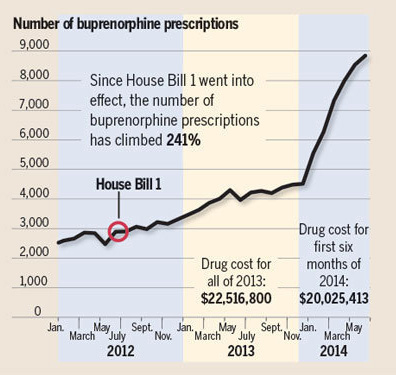
Lexington Herald-Leader chart by Chris Ware from state data
Use of the drug in Kentucky "has increased 241 percent since 2012," Meehan reports. "And 80 percent of the prescriptions for it were being written by 20 percent of the state's 470 certified prescribers, said Dr. Allen Brenzel, medical director of the state's Department of Behavioral Health. . . . Since 2011, 10 doctors have been sanctioned by the Kentucky Board of Medical Licensure because of problems prescribing Suboxone."

Suboxone is supposed to be taken in conjunction with therapy and drug testing. "a patient receives a controlled dose of a legal drug as the dose is tapered by a physician for a safe and effective withdrawal," Meehan notes. However, "doctors started to see Suboxone patients on a cash basis, asking for as much as $300 for an office visit that included a prescription for the maximum allowable amount of Suboxone. Patients often received no therapy or drug testing. Some patients were on the maximum dose indefinitely, Brenzel said." Some doctors prescribed the drug with other painkillers, creating an illegal market.

To prevent such abuse by unscrupulous doctors, the medical-licensure board has issued regulations that require "more physician education and the requirement that the drug be prescribed only for medically supervised withdrawal and not be given to pregnant women," Meehan writes. "Patients should also be closely monitored and drug tested. If those rules are not followed, a doctor can face sanctions or restrictions to his medical license."

Suboxone was in the national news recently because the accused killer in the Charleston, S.C., shootings was arrested for illegal possession of it four months ago at a South Carolina shopping mall, the Herald-Leader notes.
Read more here: http://www.kentucky.com/2015/06/20/3910362_the-drug-that-was-supposed-to.html?rh=1#storylink=cpy

Read more here: http://www.kentucky.com/2015/06/20/3910362_the-drug-that-was-supposed-to.html?rh=1#storylink=cpy

Saturday, June 20, 2015

Three doctors, nine others in western half of Kentucky are indicted in the largest-ever federal 'takedown' of Medicaid fraud

Former Dr. Fred Gott of Bowling Green was arrested.
(Photo: Miranda Pederson, Bowling Green Daily News)
Twelve people in the western half of Kentucky, including three doctors, have been charged with Medicaid fraud in what the federal government calls its biggest-ever "takedown" of the problem, Andrew Wolfson of The Courier-Journal reports.

The indictments allege "a half-dozen schemes involving nearly $8 million in alleged fraudulent billings," Wolfson writes. "The offenses include $5 million in false billings for muscle-relaxant injections that were never delivered to patients, as well as a staged car wreck in which three people allegedly conspired to get controlled substances and fraudulent reimbursements."

In another case, Wolfson reports, "a medical practice that treated car wreck patients is accused of using the DEA numbers of nurse practitioners to order hydrocodone for herself and falsely billing it to an insurance company. Nationally, the sweep resulted in charges against 243 people, including 46 doctors, nurses and other licensed medical professionals."

John Kuhn, acting U.S. attorney for the Western District of Kentucky, told Wolfson that about $1 billion of annual Medicare and Medicaid expenses are fraudulent. Medicare is the federal health-insurance program for people over 65; Medicaid is the federal-state program for the poor and disabled.

Former Dr. Fred Gott of Bowling Green, a 63-year-old cardiologist, was charged with "conspiracy to dispense controlled substances, health care fraud and money laundering," Deborah Highland reports for the Bowling Green Daily News. "The Bowling Green-Warren County Drug Task Force opened an investigation into Gott’s practices after Warren County Coroner Kevin Kirby alerted the task force about drug overdose deaths involving Gott’s patients, task force director Tommy Loving said."

Saturday, June 13, 2015

Seniors get a lot of anti-anxiety drugs, sometimes in dangerous combination with narcotics; Ky. ranks third in the nation in that

When Medicare's drug program, called Part D, was put into place more than a decade ago, Congress decided to not pay for anti-anxiety medications. In 2013, when Medicare started paying for them, the program went from spending nothing for these medications to paying more than $377 million, Charles Ornstein and Ryann Grochowski Jones report for ProPublica, a nonprofit, investigative news organization.

Using anti-anxiety drugs in combination with narcotics increases the risk of overdoses, but Kentucky has many doctors who prescribe a lot of both. More than 100 Kentucky doctors each wrote at least 1,000 prescriptions for both types of drugs in 2013, according to data compiled by ProPublica.

That ranked Kentucky third in the nation, trailing only Florida and Alabama. Other southeastern states dominated the top 10. California, the nation's most populous state, ranked eighth; Tennessee was fourth and Ohio was ninth.

ProPublica has an application that lets you look up, by doctors' names, cities or ZIP codes, the number of Medicare claims they filed in 2013, the amount of money, the number of patients and the number of prescriptions for brand-name drugs.

The anti-anxiety drugs, some known as benzodiazepines, include popular tranquilizers such as Valium, Xanax and Ativan. 

Lawmakers initially chose to keep them out of Medicare Part D because they had been linked to abuse and an increased risk of falls among the elderly. Doctors kept prescribing them to Medicare enrollees, who found other ways to pay for them.

In 2013, the year Medicare started covering benzodiazepines, it paid for nearly 40 million prescriptions, ProPublica found. Generic versions of Xanax (alprazolam), Ativan (lorazepam) and Klonopin (clonazepam) were among the top 32 most-prescribed medications in Medicare Part D that year.

The American Geriatrics Society "discourages the use of benzodiazepines in seniors for agitation, insomnia or delirium because they can be habit-forming and disorienting and their effects last longer in older patients." The society does say the drugs "are appropriate to treat seizure disorders, severe anxiety, withdrawal and in end-of-life care," ProPublica notes.

One geriatric psychiatrist told ProPublica that the drugs are a "very real safety concern" for the elderly, and that he and others in his field don't use them as a "first-, second-, or third- line of treatment." Some geriatric psychiatrists have voiced concerns that these drugs are now being used instead of antipsychotics, since Medicare has pushed to reduce the use of antipsychotics, particularly in nursing homes, because of their risks.

Several doctors who rank among Medicare's top prescribers of the drugs told ProPublica that any risks of anti-anxiety drugs are outweighed by their benefits. One said that the drugs worked well for his patients, many of whom were trying to kick addictions to narcotics, but struggled with anxiety and depression.

However, ProPublica also found that some doctors appear to be prescribing benzodiazepines and narcotic painkillers to the same patients, which increased the risk of misuse and overdose. That's where Kentucky ranked third.

Dr. Leonard J. Paulozzi, a medical epidemiologist at the federal Centers for Disease Control and Prevention, co-authored an analysis showing that benzodiazepines were involved in about 30 percent of the fatal narcotic overdoses that occurred nationwide in 2010, ProPublica reports.

Sunday, May 31, 2015

Paducah Sun looks at two local doctors who write many prescriptions for painkillers; such local data are easily available

The Paducah Sun has used some easily available information about two local doctors to shine a local light on their heavy prescribing of opioids.

The story by Laurel Black begins, "As narcotic painkiller abuse has drawn more public attention, two Paducah physicians  who have been ranked high among prescribers of such drugs  have found themselves defending their practices."

The story cites The Courier-Journal's analysis of 2012 Medicare data that showed Dr. Yogesh Malla of Paducah was "the No. 3 prescriber of narcotic painkillers in the commonwealth. A USA Today article listed Dr. Riley Love, also of Paducah, as 20th in the nation. Both reports used information the news organization ProPublica obtained under the Freedom of Information Act."

The Sun offers a quick retort from the medical director of the pain-management center where Malla practices, paraphrasung him as saying "the reports omit or minimize important factors, such as the specialty of the physicians and the morphine equivalence of the drugs they prescribe."


Dr. Laxmaiah Manchikanti also said in his written statement that his group emphasizes drugs with lower abuse potential and that more than 92 percent of patients at such centers "are already on long-term opioids; consequently, the best we can do (at these centers) is reduce the dosage."

Manchikani is CEO of the American Society of Interventional Pain Physicians, a lobbying group that advocates monitoring of painlkiller prescriptions, and a leading contributor to a wde range of political causes. The Sun doesn't note the latter point, but focuses on the issues of painkiller abuse, a major problem in Kentucky.

"With more than 1,000 deaths per year, Kentucky in 2013 had the third-highest drug overdose mortality rate in the United States, according to the Trust for America's Health," Black notes.


As for the other doctor, the Sun reports, "ProPublica's data on Love, who practices at the Lourdes Pain Management Center, reports that 59 percent of his 1,141 patients filled one or more prescriptions for a Schedule 2 drug and 51 percent filled for a Schedule 3 drug. Both figures are above the average of 45 percent and 41 percent, respectively, for his specialty in Kentucky.


"A spokeswoman for Love said Lourdes center represents the only location in the region where Medicaid patients receive inpatient pain consultations," the Sun reports, quoting her: "The patients we see are often very sick, and the treatments and medications we provide are the last resort comfort measures so the patients can spend quality time with family" as they near death.

The story is behind the Sun's paywall.

Friday, May 22, 2015

Video streaming for consultation with doctors expands and becomes more popular; 2 Ky. insurers use it and another plans to

In the past, people had to go to the emergency room to receive medical attention if they required it outside the usual hours for doctors. Now telemedicine programs such as KentuckyOne Health's "Anywhere Care" and Anthem BlueCross BlueShield's "LiveHealth Online," Kentuckians can access a doctor 24/7 through a computer or mobile device.

Photo from The Lane Report
"Patients like telemedicine because it's fast and easy to use and cheaper because it's a low-overhead service," Esther Zunker writes for The Lane Report, a Lexington-based business magazine.

UnitedHealthCare, a Minnesota-based health benefits provider for many people in Kentucky, plans to cover Skype-based doctor visits through "NowClinic," "Doctor on Demand" and "American Well." Anywhere Care and Live Health Online give clients a list of certified doctors they can chat with through video on a computer or a mobile device. The doctors can provide diagnosis and treatment and even write a prescription. They can direct patients to an emergency department if necessary.

It's affordable, too. A LiveHealth Online appointment costs the same as an office visit for eligible members. LiveHealth doctors usually charge $49 per online "visit." Anywhere Care costs $35 per visit, even if patients don't have insurance.

"As we know, care can be limited and is based on being able to get someplace when [a doctor] has an opening," said John Jesser, Anthem's vice president of provider engagement strategy. "They only have certain hours, and that doesn't always work for when people don't feel well. [Telemedicine] expands access to care for the consumers, making it much more friendly to their schedule and lifestyles."

Telemedicine is also convenient for doctors. It saves money for hospitals and allows one doctor in one location to help patients in a variety of locations. Patients can receive help with chronic conditions over periods of time without having to travel to the doctor's office.

"We've had amazingly positive feedback from patients who have tried this service," said Kathy Love, director of strategy and business development for KentuckyOne Health's Central East Kentucky Market. "People have told me they've used it multiple times when they've needed it . . . either late at night or over the weekend."

She also said people who use telemedicine still need a primary-care physician: "It's something you can access 24 hours a day with a very minimal wait and very professional providers, but it shouldn't replace your very important relationship with your primary-care doctor." (Read more)

Thursday, May 7, 2015

UK HealthCare offers help to primary-care clinics; university's top health official calls it 'a game changer' for rural health providers

The Kentucky Primary Care Association and the University of Kentucky have announced a new partnership to provide support services to primary care providers throughout Kentucky.

This "groundbreaking partnership" will provide KPCA, which includes more than 800 patient care providers, access to UK HealthCare's support services, such as supply chain contracts, medical professional placement services, practice transformation support and training, and an after-hours pediatric call triage center, according to press release.

The most notable feature of the partnership is that KPCA members will have access to UK's group purchasing contracts, giving them access to services at heavily discounted rates at no charge to the facilities. This is expected to create "significant" savings for more than 250 clinics throughout the state. UK's top health official called it "a game changer."

“Primary care physicians, especially those in rural areas, have the extra burden of high patient volume, limited staff, and stretched resources,” Dr. Michael Karpf, UK's executive vice president for health, said in the release. “By partnering, UK HealthCare and KPCA members can grow important programs and services for their patients while also controlling and reducing operating costs.”

KPCA Executive Director Joe Smith said, "By addressing some of these issues related to costs, clinics with already scarce resources can instead focus on improving the quality of care.We’ve had a longstanding association with the university and UK HealthCare, and this partnership elevates that relationship by adding a strong commitment to assisting rural doctors, nurses and practice managers, who face some of the toughest transitions taking place in medicine today.”

The partnership will also allow KPCA members access to staffing services that link candidates to vacancies across the state; to Patient Centered Medical Home consultants, who help practices transition to quality and value-based models of care; and to UK HealthCare's after-hours pediatric call triage service.

Friday, March 27, 2015

How has the federal health-reform law changed your care?

Despite the controversy that continues to surround the Patient Protection and Affordable Act five years after its passage, it has probably changed the way your health care is delivered as it drives new models of payment, forces providers to approach care differently, and changes how health care is evaluated, Kavita Patel and Domitilla Masi report for the Brookings Institution.

Here are five ways the authors say that your health care might be different than it was five years ago because of the reform law:

Your physician might be part of a patient care team. New payment models in the ACA encourage an interdisciplinary team-based approach, which evidence shows "can lead to higher quality care and better health outcomes for patient." This approach allows the physician to spend more time diagnosing and devising a treatment plan, while the patient may spend more time interacting with non-physician staff for support care.

Prevention and wellness are more important than ever. The ACA requires health plans to cover all preventive screenings, immunizations and well visits for women at no cost, as part of the minimum benefits required in order for health-insurance plans to participate in exchanges like Kynect. The new payment models also pay physicians who work toward keeping their patients healthy, instead of just treating them when they are sick. " Since the policy took effect in September 2010 it is estimated that an additional 76 million people now receive preventive care," the authors write.

You may have better access to care on evenings and weekends. New payment models are driving this change as practices are often required to offer extended hours to decrease the overuse of emergency departments. Many offices now offer clinical advice around the clock with a clinician who has immediate access to their medical records.

Chances are your health information is being stored in an electronic health record, not a paper file. A separate law encouraged the use of EHRs, but "participation in the new ACA-promoted delivery models is practically impossible" without them. And while EHRs can be used to greatly improve patient care, not all EHRs are created equal and it will take time before patients see seamless integration and exchange between different doctors and settings in "real-time".

You can access care remotely, wherever you are. Doctors are using mobile technology and tele-health in rural and remote areas to provide more efficient care to patients. Insurance companies and employers are beginning to recognize this mode of treatment not only as a way to save money, but to also provide timely access to care, that does not involve the emergency room.

Thursday, March 19, 2015

Community health groups, with focus on prevention, fight to be part of new setup for lowering health costs, improving outcomes

The Patient Protection and Affordable Care Act is forcing doctors and hospitals to collaborate on lowering health-care costs while improving health outcomes. Community health groups that focus on preventive care are battling to be included as part of the solution, Laura Ungar reports for The Courier-Journal and USA Today.

One way physicians and hospitals are coming together to "reduce the duplication of services and keep large groups of patients well" is by forming accountable care organizations. Community health groups are having to fight for a "seat at the table" in these "doctor-dominated boards of ACOs," Ungar writes.

Such groups often offer less expensive, non-medical solutions for preventive health, according to a 2014 report by a North Carolina physicians' coalition. Some ACOs are beginning to include them as partners, but Bo Bobbitt, a Raleigh health-care lawyer who was lead author of the report, told Ungar, "The bad news is that the gap between the medical system treating illness and disease and the community health system was larger than we had feared."

Jose Pagan, a health economist who directs the New York Academy of Medicine's Center for Health Innovation, told Ungar that another key challenge is that doctors and hospitals are going to keep working to keep the money flowing their way. "If you go to a surgeon for a solution, they're not going to give you massage therapy," he says. "There's going to be progress, but it's going to be very slow."

Traditionally U.S. health care has focused its attention on "costly medical intervention," Ungar reports, instead of lifestyle changes, with only 3 percent of the $2.6 trillion health-care budget being spent public health and prevention, despite preventable chronic conditions accounting for 75 percent of medical care, according to a 2012 Institute of Medicine report.

"Compared to even the best medical therapy, we can decrease heart attacks, strokes and deaths by between 35 percent and 45 percent by changing lifestyle," Paul Rogers, a Louisville cardiologist at one of KentuckyOne Health System's healthy lifestyle centers, told Ungar.

For example, losing about 10 percent of weight reduces cardiac risks significantly, and losing 15 to 20 percent begins to reverse diabetes, lowers blood pressure, improves sleep and improves cholesterol level, Rogers said.

Another challenge for community-based programs is that little money goes into research on wellness programs, "and without studies, few will invest in their programs," Ungar notes.

Some members of Congress don't see nutrition, physical fitness or stop-smoking campaigns as health funding and gripe about the "nanny factor," Georges Benjamin, a physician who is executive director of the American Public Health Association, told Ungar.

As a result, "annual funding authorized by the ACA for the Prevention and Public Health Fund was supposed to hit $2 billion starting in 2015 but won't reach that level until at least 2022," Ungar reports.

Lifestyle changes are known to help chronic conditions, and Ungar gives many examples in the article. Here is one: Kevin French, 57, a construction contractor in Louisville, told Ungar that he began having chest pain and had to have two stents implanted in his heart in 1993.  And through cardiac rehab, he learned that his previous eating habits, which included lots of fast food, lack of exercise and smoking, played a big part in his heart problems. But with the help of the healthy lifestyle center, he said he  has "basically changed everything" about  his lifestyle and that's "improved not only his health but his family's as well."

Monday, March 9, 2015

Bardstown hospital sponsors monthly 'Walk With a Doc'

Here's an interesting idea to promote physical activity and maybe even health literacy: take a walk with your doctor.

Flaget Memorial Hospital in Bardstown hosts monthly "Walk With a Doc" events as part of a nationwide program. Participants can also receive complementary health screenings at the event, says a news release from KentuckyOne Health, which owns Flaget.

"According to America Walks, brisk walking has been shown to reduce body fat, lower blood pressure, increase high-density lipoprotein, and even reduce risks of bone fracture," the release says. "Not only that, it is also associated with lower mortality rates from cardiovascular disease and cancer."

The walks begin at 10 a.m. on the second Saturday of each month, so the next one is March 14. The walks begin at the Court Square in the middle of Bardstown. For more information, call 502-350-5040.

Thursday, March 5, 2015

State Senate passes bill for independent appeals process for managed-care claims; hearing gets into details of the problem

By Melissa Patrick
Kentucky Health News

Managed-care organizations' contracts allow them to deny Medicaid claims and not reimburse for services if they deem them not medically necessary. That means health-care providers often don't get paid for providing care, and their only recourse is an internal review by the MCO.

Sen. Ralph Alvarado
"It appears some of our MCOs are using this denial method in order to, as they term it, 'manage care'," Republican Sen. Ralph Alvarado said at a Senate Health and Welfare Committee hearing on his Senate Bill 120, which would set up an independent appeals process for providers, much like those in Georgia and Virginia.

The  bill, which had been in the works for several years, passed the Senate March 2 and was received in the House March 3. Its prospects in the House appear poor because it is opposed by the Cabinet for Health and Family Services, which oversees Medicaid. Its main targets are MCOs WellCare of Kentucky and Coventry Cares of Kentucky.

Alvarado, a Winchester physician, said in an interview that he pointed out these companies because they have the highest denial rates. While other companies also have complaints, "They are very small and minor, what you would expect in the normal course of business," he said. "It is WellCare and Coventry; these two are the names that keep coming up over and over again."

Asked for comment, Coventry said in an e-mail, "Coventry continues to monitor the legislation as it moves through the process. We are working with lawmakers to protect the integrity of the managed Medicaid program and be responsible with taxpayer dollars."

WellCare said in an e-mail that its appeals process is adequate, offering two additional remediation alternatives, negotiation and arbitration. The company said MCOs are "continuously subjected to rigorous oversight by state, federal and national accreditation entities," which ensure that they "adhere to strict standards and evidence-based guidelines in determining medical necessity."

Nina Eisner, board member of the Kentucky Hospital Association and chair of its Chemical Dependency Treatment Program, told the committee that providers deserve the same sort of state appeals process that patients have for denial of service.

"Kentucky's providers are under tremendous pressure from payment cuts from Medicare and slowed and denied payments by MCOs," Eisner said. "It is untenable and unreasonable to expect that Kentucky providers can provide health care services for free."

She said that many of the disputes stem from MCO reviews using out-of-state physicians who "don't always understand the rural nature of our state and the lack of resources." She said one example is discharging rural patients from inpatient to outpatient behavioral-health or substance-abuse treatment where no outpatient services are easily acessible.

"The MCOs in Kentucky are quite profitable," Eisner said, citing a November analysis by Citi Research that found Kentucky's MCO plans generated over $450 million in earnings before interest, taxes and depreciation from the state Medicaid program. "This is a margin of 10.6 percent, which is more than two times the 3 to 5 percent margin most Medicaid plans target."

Sen. David Givens, R-Greensburg, said he was compelled to remind those at the hearing that private companies need to be profitable to keep the system working. Later, Sen. Danny Carroll, R-Paducah, disagreed, saying MCOs' profits need to be more balanced.

Medicaid Commissioner Lisa Lee said that it is balanced, because MCOs were required to spend 87 percent of their payments on the population newly eligible for Medicaid or give it back to the federal government, and that rates going forward depend on what they spend today.

KHA's Nancy Galvagni said another reason for a state appeals process is the variation between plans' denial rates, ranging from a low of 7 percent to a high of 18 percent. She said that providers have gone to state hearings on behalf of their patients and had favorable opinions, only to have them overturned by the Cabinet.

Tina Heavrin, general counsel for the cabinet, said that occurs because the cabinet only has authority to decide whether patients received services, and if they did, there is no claim and any dispute regarding payment is between the MCO and the health-care provider.

Sen. Julie Raque Adams, the committee chair, replied, "I think that is the impetus behind this bill, that once the patient receives their service, they are done, but the provider is not. ... I don't want to go to work and not be paid for it. And I don't think that is an unreasonable thing to request or require and I think that is all that this bill does."

Heavrin said that providers do have a process to resolve these issues, "It is called the judiciary." She said the cabinet can't run an appeals process for MCOs because it "as part of the executive branch, doesn't have jurisdiction or legal authority over an adjudication of private contract rights." She added, "The MCOs are our contractors and it would be difficult to not have a financial interest in the outcomes of those appeals," meaning that upholding an appeal would cost the state money.

Lee said the cabinet acknowledges issues with MCOs. She said that while state officials should not get in the middle of contract disputes, "We do listen to our providers" and "want to hold our MCOs accountable," noting that they had "made some significant progress with managed care" since its inception in 2011.

Carroll, who deals daily with MCOs through his non-profit agency that provides therapy services and medical-based child care, said, "It is an absolute nightmare dealing with MCOs," because of all the "hoops to jump through in order to get reimbursement."

He asked if there was any way for the cabinet to work these issues out in its new contracts and said it felt like the state had "brought in these MCOs and basically washed their hands of all the issues associated with it."

Heavrin said it would not be possible to include a state appeals process in the contracts because "We can't be a judiciary."

Lee told Carroll that state officials had not "washed their hands" of the MCOs and closely monitor their activities. "We also have an obligation to the Center for Medicare and Medicaid Services to make sure that every single thing that we pay for does meet medical necessity," she said. CMS is the federal agency that oversees those programs.

Thursday, February 5, 2015

Senate OKs bill for review panels in medical lawsuits after lively debate between doctors, lawyers, others

This story, which was published Thursday morning, has been updated with action in the full Senate.
By Melissa Patrick
Kentucky Health News

FRANKFORT, Ky. -- The Senate has approved a bill that advocates say will help weed out "frivolous" medical malpractice lawsuits and speed up litigation for legitimate suits.

Alvarado
"Right now, Kentucky has one of the nations most litigation-friendly environments, making our commonwealth a prime and profitable target for personal injury lawyers preying upon our health care providers," Sen. Ralph Alvarado, R-Winchester, a physician and sponsor of Senate Bill 6, told the Senate Health and Welfare Committee. Opponents disputed that claim.

The Senate passed the bill Thursday 24-12. It is not expected to pass the House.

The bill would establish panels of three medical experts, two chosen by each side and the third chosen by the other two, to review suits against health-care providers to determine if the case has merit before the lawsuit can proceed. Panel findings would be admissible in court but not legally binding.

The Republican-controlled Senate passed a very similar bill last year but it got nowhere in the Democrat-controlled House, and its prospects are similar this time. However, Wednesday's committee meeting provided a detailed and lively explication of the issue, lasing almost two hours.

Vanessa Cantley, a Louisville personal injury attorney, told the committee that most medical malpractice cases are legitimate. She cited a Harvard University study published in the New England Journal of Medicine that concluded "portraits of a malpractice system that is stricken with frivolous litigation are overblown" and reported that 97 percent of claims for medical injury evaluated over a decade were deemed to be meritorious.

However, Michael Sutton of Louisville, a civil defense attorney, said defendants win 80 per cent of medical malpractice suits.

Cantley said there are 2,700 deaths in Kentucky each year due to purely preventable medical error, but, according to the state Department of Insurance, fewer than 500 lawsuits a year are filed by abuse and neglect victims. She spoke for the Kentucky Justice Association, formerly the Kentucky Academy of Trial Attorneys.

Alvarado and other opponents argued that Kentucky has become a haven for such lawsuits and bills like his have helped deter them. "Medical review panels are a proven solution for limiting baseless claims brought by a personal injury lawyer to ensure a faster, more efficient path for patients with legitimate claims, " he said.

Alvarado said the state is 4,000 doctors short of its need and the legal climate in Kentucky makes it hard to recruit and retain doctors. Sen. Julie Raque Adams, R-Louisville, the committee chair, said the expansion of Medicaid in Kentucky makes it all the more important to make the state attractive to doctors. "Anytime there's a paradigm shift, there are other policies that  need to go along with that paradigm shift," she said.

Dave Adkisson, president and CEO of the Kentucky Chamber of Commerce, said review panels "will stabilize our medical malpractice system and make our state more attractive" and "protect the legitimate cases while weeding out the meritless claims," which increase costs to consumers and employers through higher premiums and defensive medicine in the form of extra medical tests.


Kentucky's constitution bans laws that would cap damages
in lawsuits. (Care First Kentucky graphic)
Every state surrounding Kentucky offers some level of protection against medical malpractice, while Kentucky offers no legal protections for healthcare providers, according to Care First Kentucky, a business coalition supporting the bill.

Sen. Reggie Thomas, D-Lexington, a lawyer, argued that Kentucky already has laws to punish attorneys for filing frivolous cases. Alvarado said the rule isn't used much because judges "allow a lot of latitude," and Sutton said it is reserved for "really egregious conduct."

Cantley argued, subtly, that courts are the refuge for patients who suffer from abuse, neglect and malpractice. She said the federal Centers for Medicare and Medicaid Services has ranked Kentucky No. 1 in nursing-home deficiencies, and argued that state boards that discipline doctors do a poor job.

The full Senate's debate on the bill was cut short because the committee adopted a substitute version, preventing Democratic Leader Ray Jones of Pikeville, a plaintiffs' lawyer, from offering any of his amendments, which had been drafted to the original bill. Under traditional procedures, a bill gets its required readings on days between the committee meeting and the floor vote, but in recent years Republicans have given important bills readings before committee action, allowing a vote on them the day after they pass a committee.

Tuesday, January 27, 2015

Medicare starts to overhaul the way it pays providers, rewarding them for quality, penalizing them for shortcomings

By Molly Burchett
Kentucky Health News

The Obama administration on Monday set a timeline for historic changes in how it pays doctors, hospitals and other health providers under Medicare, shifting away from the program's traditional fee-for-service model and towards a model that rewards care quality.

Rather than give the usual yearly fee increases to Medicare doctors for every procedure or service, the Department of Health and Human Services will tie 30 percent of traditional, fee-for-service payments to models like "accountable care organizations," which base payments (and penalties) on patients' health outcomes. The goal is for half of all Medicare payments to be handled this way by 2018, reports Jason Millman of The Washington Post.

"Today's announcement is about improving the quality of care we receive when we are sick, while at the same time spending our health-care dollars more wisely," said HHS Secretary Sylvia Burwell. "We believe these goals can drive transformative change, help us manage and track progress and create accountability for measurable improvement."

Medicare is the country's largest payer for health-care services, so these payment changes will affect doctors' offices and hospitals across the country. Many experts have viewed this broader shift to rewarding care quality as long overdue, but it's still uncertain how well the approach will work.

"We still know very little about how best to design and implement [value-based payment] programs to achieve stated goals and what constitutes a successful program," concluded a 2014 Rand Corp. study funded by HHS, Millman reports.

Some health-care professionals said Medicare is just aligning with what is already working in the private sector by moving away from fee-for-service, reports Alex Wayne of Bloomberg Businessweek.  “The private sector is further ahead than Medicare right now,” said Justine Handelman, vice president for legislative and regulatory policy at the Blue Cross and Blue Shield Association.

Since Medicare is already limiting payments as part of the 2010 health-reform law, the government must “ensure that only reforms proven to be efficient and effective are put in place,” Chip Kahn, CEO of the Federation of American Hospitals, told Wayne. “Further cuts would undermine our ability to invest in delivery system innovations needed to continue this trend.”

The announcement marks the first time that goals have been set to fundamentally change the way Medicare pays for health care, giving providers incentives to reduce unnecessary services.

Dr. Douglas Henley, CEO of the American Academy of Family Physicianstold CNBC: "We're all partners in this effort focused on a shared goal. Ultimately, this is about improving the health of each person by making the best use of our resources for patient good. We're on board, and we're committed to changing how we pay for and deliver care to achieve better health."

Sunday, December 28, 2014

U.S. study finds Medicaid patients may have hard time finding doctor; half not taking new patients or not at given location

By Melissa Patrick
Kentucky Health News

The expansion of Medicaid in Kentucky and other states under federal health reform has provided more people than ever with health coverage, but finding a doctor who will accept Medicaid patients could be a problem, a study has concluded.

The inspector general of the U.S. Department of Health and Human Services found that half the doctors who are supposed to see Medicaid patients either aren't taking new patients or couldn't be found at their last known address.

Kentucky has not received "many such complaints" from Medicaid participants saying they could not find a doctor, but they're in a clear minority, Gwenda Bond, spokeswoman for the state's Cabinet for Health and Family Services, said in an e-mail.

"We survey Medicaid members annually and they report a high (approximately 90 percent) satisfaction rate with finding a doctor," Bond said. She noted that customer-service lines of Medicaid managed-care organizations "can help members find doctors and new members are also assisted with finding a physician when they sign up."

As of Nov. 1, more than 1.2 million Kentuckians were on Medicaid, including 358,703 who were newly eligible because of the expansion under the Patient Protection and Affordable Care Act. Approximately 20,000 more adults who had been eligible but never enrolled are now on the program, presumably because of publicity about the expansion.
Cabinet for Health and Family Services spreadsheet
Kentucky's directory of physicians who accept Medicaid is updated monthly, but it does not indicate those who are not taking new patients, Bond said. As of December, the directory listed 14,593 physicians; 1,835 physician groups; 3,470 advanced registered nurse practitioners; 615 ARNP groups; 810 physician assistants; and 204 PA groups. The list does not include specialists.

In the federal study, 8 percent of the doctors located in the survey participated in Medicaid but were not accepting new patients. Another 8 percent who were found at the locations listed said they did not participate.

The study was based on phone calls to a stratified random sample of 1,800 doctors listed by health plans under contract with Medicaid in 32 states. It found that 35 percent of the providers could not be found at the location listed by a Medicaid managed-care plan.

“In these cases, callers were sometimes told that the practice had never heard of the provider, or that the provider had practiced at the location in the past but had retired or left the practice. Some providers had left months or even years before the time of the call," the study report says.

“When providers listed as participating in a plan cannot offer appointments, it may create a significant obstacle for an enrollee seeking care,” the report says. “Moreover, it raises questions about the adequacy of provider networks. It suggests that the actual size of provider networks may be considerably smaller than what is presented by Medicaid managed-care plans.”

The study also found long wait times for the doctors who accepted Medicaid patients.

The median wait time was two weeks for providers who offered appointments, but more than one-fourth of providers had wait times of more than a month and 10 percent had waits longer than two months. Specialists were more likely to offer appointments than primary-care providers, but had a median wait time of 20 days.

The study recommended that the Centers for Medicare & Medicaid Services assure that each state's provider network is accurate and adequate, and to make sure that states are complying with the existing state standards for wait times. CMS agreed with these recommendations.

Friday, November 28, 2014

St. Joseph London, doctors and others win the first of a dozen trials over allegations of unnecessary procedures at hospital

A jury has decided for the St. Joseph London hospital, several of its doctors and other defendants in a lawsuit that accused them of conspiring "to perform unnecessary, risky and often painful heart procedures to unjustly enrich themselves," Andrew Wolfson writes for The Courier-Journal.

After a three-week trial of the suit filed by Ed Marshall, the Laurel Circuit Court jury took only 40 minutes Nov. 21 to decide there had been no wrongdoing, Nita Johnson reports for The Sentinel-Echo. However, The C-J reports that the case was only the first of 12 "that will be tried to show the value of the cases to both sides, according to Louisville lawyer Hans Poppe, one of the plaintiff's lawyers. . . . He said Marshall had suffered five heart attacks before he was allegedly given an unnecessary stent and that the jury may have been reluctant to fault the defendants given his complex prior medical history."

"Marshall’s lawsuit spurred five other cardiology patients to step up with claims that the doctors were doing unnecessary procedures on patients with heart problems," Johnson reports. "The list of lawsuits continued to expand, with numerous patients and the family members of deceased patients joining in with the claims that the cardiologists were performing procedures that were not medically necessary. Before all was said and done, over 200 people had filed lawsuits against the London hospital, its owning agency – Catholic Health Initiatives; the cardiovascular company that referred patients to the local hospital, the medical billing organization, and individual cardiologists involved in certain procedures. One of those cardiologists – Sandesh Patil – is serving federal prison time for falsely billing Medicare for procedures" that the Kentucky Board of Medical Licensure said didn't meet minimum guidelines.

In January, the hospital agreed to pay the federal government $16.5 million to resolve "civil allegations that it submitted fraudulent claims to the Medicare and Kentucky's Medicaid programs for unnecessary heart procedures," Wolfson notes. The deal also put the hospital under a corporate integrity agreement, and its president and chief nursing officer were replaced in September by officials who have experience in operating under such agreements, R. Scott Belzer reported for The Sentinel-Echo.

Sunday, November 23, 2014

Conference focuses attention on importance of patient- and family-centered care, health education, communication

Health education, communicating with physicians, and patient- and family-centered care that empowers patients to be their own best health advocates, were some of the topics discussed at the Health Watch USA conference in Lexington this month.

Joycelyn Elders
“Patient empowerment is the right of the patient to take an active role in decisions about his or her own care,” said former U.S. surgeon general Joycelyn Elders, professor emeritus of pediatric endocrinology at the University of Arkansas. “But you can't make a good decision if you have not been educated. You can't keep an ignorant population healthy.”

Waiting until a person is old and set in their ways and then trying to teach them better health strategies doesn't work, Elders said. For patients to really be involved in their health, health education must start early.

“We must push for comprehensive health education in our school systems from kindergarten through 12th grade,” she said. “It is just as important as teaching reading, writing, and arithmetic. . . . We need to have science-based answers rather than ubiquitous myths. We need to protect people by arming them with correct information.”

Elders offered some practical suggestions to help patients become more empowered during their doctor's visits:
  • Take a trusted person with you.
  • Ask questions if you don't understand.
  • Bring all of your medications with you.
  • Write down questions and concerns before you go.
  • Ask your doctor to write down information and instructions discussed.
  • Make sure to tell your doctor if you have vision or hearing problems.

Elders said health education for physicians could also be improved, by putting more emphasis on preventive care and the treatment of chronic diseases, which are 75 percent of diseases in the United States, rather than acute diseases.

“We spend only 3 percent of our health-care dollars on keeping people well,” Elders said. “We have to do a better job. We haven’t educated our doctors.”

Karen D. Meyers
Karen D. Meyers, a lawyer who works with catastrophic-injury victims and health-care providers, said medical schools must start teaching doctors how to become better collaborators, not only between specialties, but with their patients as we move toward a model of patient and family centered care.

“They must learn to treat patients with dignity and respect, listen and share information with their patients, and allow patients to participate in their care,” said Meyers, who became an advocate for patient- and family-centered care after becoming a health advocate for her mother, who was in a coma for 40 days.

Elders said patient empowerment requires the patient to take some responsibility for his or her care, which requires respectful communication and shared decision-making between the doctor and the patient. The current physician-patient model of care does not support this concept, Elders said: “This has to change.”

Meyers concurred, saying physicians, hospitals and patients must change the attitude of “my patient, my treatment plan, my procedure, my case” to a model that recognizes that “everything about a patient's health belongs to the patient and their family.” She added, “Patients have to understand, because they are responsible for their care.”

Health Watch USA, based in Somerset, was founded by Dr. Kevin Kavanagh to promote health care transparency and patient advocacy, according to its website. For its report on the conference, in PDF format, click here.

Sunday, November 2, 2014

Most Kentuckians who bought health insurance on Kynect will pay higher premiums next year

Most premiums for private health insurance purchased through Kentucky's health insurance exchange, Kynect, will increase in 2015.

Most of the people who have used Kynect have been added to Medicaid, the government health insurance program for the poor and disabled. Only about 85,000 Kentuckians used the site to purchase private plans.

Health insurance companies have filed their rate requests for 2015, and the state Department of Insurance has approved most of them, reports Adam Beam of The Associated Press.

Officials have approved a 15 percent average rate increase for the Kentucky Health Cooperative, which sold 75 percent of private plans on the exchange.

Humana and Anthem Blue Cross Blue Shield each sold 12.5 percent of the private plans on Kynect. Humana's premiums will rose an average of 12.8 percent, but rates for Anthem will go down an average of 4.3 percent, Beam reports. Rates apparently have not been set for two new companies that will join the exchange, CareSource and WellCare.

"Rates off the exchange are increasing, too, in both the small group and individual markets," writes Beam. For example, Time Insurance Co.'s individual rates will go up an average of 15 percent, and the small group rates for Time, Bluegrass Family Health and John Alden Life Insurance Co. will rise an average of 5 percent.

Department of Insurance spokeswoman Ronda Sloan told Beam that rates for large group plans were not available yet. The rate certification process will be finalized before open enrollment, which begins on November 15, 2014 and runs through February 15, 2015.

The averages can be misleading because that Kynect offers approximately 70,000 different rates, which vary depending on numerous variables, such as the type of plan, where people live, how old they are and whether they smoke.

Kynect was one of the few online health insurance portals that actually functioned when Obamacare launched a year ago. An estimated 521,000 Kentuckians have obtained insurance through the website, reducing the state's uninsured rate from 20 percent to 12 percent, Democratic Gov. Steve Beshear said in a recent video update.

Beshear said this sharp reduction in the uninsured proves that Kynect is working. Republicans say higher insurance premiums and difficulty finding doctors prove it isn't.

Sunday, August 31, 2014

As nurse practitioners enjoy their new, state-granted authority, The Paducah Sun looks at the issue in far Western Kentucky

Kentucky law has expanded the rights of nurse practitioners, Laurel Black notes for The Paducah Sun: "Local practitioners say the move will provide patients with better access to care, but not everyone in the medical community embraces the idea."

The new law "gives nurse practitioners who have worked with a physician for four years the right to prescribe routine medications, such as those used to treat diabetes and blood pressure, without a doctor's involvement," Black writes. But nurse practitioners want it to go farther.

The American Association of Nurse Practitioners says "19 states and the District of Columbia allow nurse practitioners full autonomy. This means they're allowed to evaluate patients, order and interpret diagnostic tests, and initiate and manage treatments, including prescribing medications," Black reports. "As the population in the United States grows and ages, providers worry over a physician shortage -- as many as 130,600 by 2025, according to the Association of American Medical Colleges -- and some providers believe nurse practitioners could fill that gap if granted more independence."

"We want to be as independent as we can, because that gives better access to patients," said Amy Fennel, a nurse practitioner at the Paducah Neurosurgical Center, told Black.

"But the idea has met with opposition from organizations such as the American Medical Association," Black notes. "The AMA argues in support of physician-led teams, stating that nurse practitioners lack the education and training to practice on their own."

Black writes, "Local practitioners say their roles are different from those of physicians, and that practicing independently is well within the scope of their training. Elizabeth Scheidler, a nurse practitioner with Mercy Primary Care in Lyon County, who was a nurse for 12 years, told Black that her training was more patient-focused.

"That makes them a good fit for the current health care climate, where primary care physicians are at a premium, particularly in rural areas," Black writes. "Kentucky's law addresses only prescription of non-scheduled medications; controlled substances still require a collaborating physician. And there's still a ways to go before nurse practitioners are able to practice with complete autonomy in the state. For the time being, Scheidler says, the new law 'is a good compromise'." The legislature wrestled with the issue for years before passing the compromise this year. (Read more; subscription required)

Sunday, July 6, 2014

Drug developed to treat addiction is being abused, so much that clinics have been opened to sell it

"Suboxone, a popular and highly touted medicine designed to get people off opioids such as painkillers and heroin, is increasingly being abused, sold on the streets and inappropriately prescribed, according to doctors and drug control and law enforcement officials," Laura Ungar reports for The Courier-Journal. "The drug combines buprenorphine, an opioid, and naloxone, which counters the effects of an overdose. Prescriptions for Suboxone and its generic equivalent rose 63 percent in Kentucky between the first quarter of 2012 and the first quarter of this year, to 113,713 from 69,640."

One reason is the state's crackdown on pain clinics that were little more than pill mills. "In lieu of that, now people are opening Suboxone clinics. Many are cash-only," Leanne Diakov, general counsel for the Kentucky Board of Medical Licensure, told Ungar. "We have seen some doctors in trouble with licenses or finances opening these clinics." Ungar found that 14 percent, or 45, of the 330 Kentucky physicians authorized to prescribe buprenorphine "have a history of discipline by the medical board."

Attorney General Jack Conway told Ungar that suboxone abuse "is certainly on my radar, but I've kind of been careful to tread lightly. Some people desperately need Suboxone. I view it as a treatment of last resort . . . not a magic pill for addiction." Doctors told Ungar that some addicts self-medicate with Suboxone and use it to stave off withdrawal symptoms "when they have nowhere else to turn," she writes