Showing posts with label health reform. Show all posts

Friday, July 3, 2015

Ky.'s pro-Obamacare policies led to more enrollment and support for it, but many poor are still uninsured and under-informed

Update: This story was updated to reflect the study's results for those who said they were hurt  by and not directly impacted by the ACA. 

State policy appears to have a major impact on poor people's thinking about the Patient Protection and Affordable Care Act, as well as how they describe their experience with it, according to a Harvard University study published in the journal Health Affairs.

The study surveyed nearly 3,000 low-income residents in three Southern states that had varying approaches to the ACA and its implementation: "Kentucky, which expanded Medicaid, created a successful state marketplace, and supported outreach efforts; Arkansas, which enacted the private option and a federal-state partnership marketplace, but with legislative limitations on outreach; and Texas, which did not expand Medicaid and passed restrictions on navigators" who help people with the federal and state marketplaces.

The survey found that Kentucky, which has enrolled more than 500,000 people in Medicaid and another 109,000 in private health plans through the Kynect health-insurance exchange, had the highest success in application rates, successful enrollments and positive experiences with the ACA, followed by Arkansas and then Texas.

"This corresponds to the general pattern of state-level engagement and support for the ACA coverage expansions in these three states," the researchers write.

The study also found that limited awareness and poor information continue to be two of the greatest barriers to the ACA. Even in Kentucky, where awareness was the highest, only half of the poor people surveyed said they had heard "some" or "a lot" about the ACA's coverage options. About 10 percent of Kentuckians remain without health insurance.

Another barrier to applying for coverage was the perception that it would cost too much, but for those with incomes below 138 percent of poverty in states that have expanded Medicaid, coverage is available without having to pay a premium.

"This adds to previous evidence that information gaps about the law remain a major challenge, particularly among low-income populations who likely have the most to gain from the coverage expansions," the researchers write.

The study also found that application assistance from navigators and others was the strongest predictor of enrollment, increasing enrollment to 93.1 percent from 84.9 percent. Application assistance was most common in Kentucky (46.2 percent) and least common in Texas (31.9 percent). Navigators help consumers choose health-insurance plans to meet their needs and assist them with the application process.

Kentucky reported an overall better application experience than the other two states in the study, and had a significantly higher enrollment rate (92.4 percent) than Arkansas (87 percent) and Texas (84.8 percent).

The study found that advertising about the law didn't seem to affect whether people applied for coverage or enrolled in a plan. However, ads were strongly associated with perceptions of the law.

About 20 percent of respondents said they had read or heard more negative ads and approximately 12 percent recalled more positive ads, and two-thirds said ads were about equal. (Negative ads were most frequently reported in Arkansas, where Obamacare was an issue in a U.S. Senate race last year.)

Twice as many respondents felt that the ACA had helped them as hurt them, although the majority reported no direct impact. In Kentucky, 40 percent said it had helped them, 12 percent said it had hurt them and 48 percent said it had not impacted them directly;  In Arkansas, 30 percent said it had helped them, 17 percent said it had hurt them and 54 percent said it had not impacted them directly; and in Texas, 21 percent said it had helped them, 14 percent said it had hurt them and 66 percent said it had not directly impacted them.

"Nonetheless, 48 to 66 percent of low-income adults in all three states felt the law had not directly impacted them in 2014," the researchers wrote, "which suggests that the ACA has not yet reached many who might benefit from it."

Sunday, June 28, 2015

More dental patients using ERs, showing lack of dental coverage, shortage of dentists and the stepchild status of oral health

More patients are going to hospital emergency rooms for dental care, illustrating how oral health remains the stepchild of the health system despite health-care reform.

"An analysis of the most recent federal data by the American Dental Association shows dental ER visits doubled from 1.1 million in 2000 to 2.2 million in 2012, or one visit every 15 seconds, Laura Ungar reports for The Courier-Journal and USA Today.

Christopher Smith of Jeffersonville, Ind., had a dental
infection that put him in a Louisville hospital for a
week. (Courier-Journal photo by Sam Upshaw Jr.)
"This is something I deal with daily," Dr. George Kushner, director of the oral and maxillofacial surgery program at the University of Louisville, told Ungar. "People still die from their teeth in the U.S."

A longstanding federal law requires ERs to treat patients regardless of their ability to pay. "Although they often provide little more than painkillers and antibiotics to dental patients, the visits cost more than three times as much as a routine dental visit, averaging $749 if the patient isn't hospitalized — and costing the U.S. health care system $1.6 billion a year," Ungar reports.

Private dental insurance is not common. "Just over a third of working-age adults nationally, and 64 percent of seniors, lacked dental coverage of any kind in 2012, meaning they had to pay for everything out of pocket," Ungar writes. The Patient Protection and Affordable Care Act "requires health plans to cover dental services for children but not adults," and "Medicare generally doesn't cover dental care at all," she notes.

In Kentucky, the expansion of Medicaid under Obamacare has increased dental visits in the program by 37 percent, but it offers "only a short list of dental services," such as extractions, which patients often choose instead of restorative work, for which they would have to pay.

Another big issue is that many dentists don't accept Medicaid, which pays them only 41 percent of private reimbursement, Ungar reports. Also, Kentucky has a shortage of dentists. "A 2013 workforce study by Deloitte Consulting found the state needs 612 more to meet demand," Ungar notes.

More dentists would encourage more preventive treatment, which dentists say would save a lot of money. "If we were going to the dentist more often, we could avoid a lot of this," Dr. Ruchi Sahota, a California dentist and consumer adviser for the ADA, told Ungar. "Prevention is priceless."

Fewer than 60 percent of Kentuckians saw a dentist in 2013, making their dental-visit frequency 43rd in the nation, according to the Kentucky Health Issues Poll.

Sunday, June 21, 2015

Kentucky is cracking down on Suboxone, a heroin substitute that has become a big part of the illegal trade in painkillers

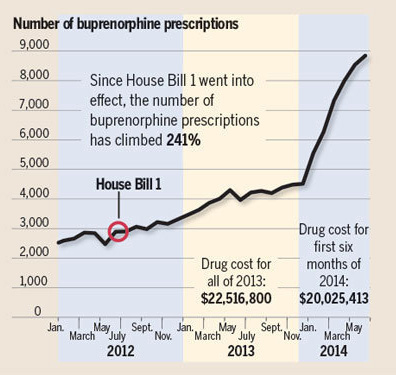
A drug that was supposed to help people get off heroin has "created a new cash-for-pills market and a street trade" that state officials are trying to stop, Mary Meehan reports for the Lexington Herald-Leader.

The drug is buprenorphine, the active ingredient in the brand-name drugs Suboxone and Subutex, which became more popular in 2012, when the state cracked down on "pill mills" that were freely handing out prescriptions for painkillers. "A lot of the pill mills morphed into facilities that dispense these prescriptions," Dr. John Langefeld, medical director for the state's Medicaid program, told Meehan.

Also, Meehan writes, the Patient Protection and Affordable Care Act required insurance plans to cover treatment for substance abuse, and "as more Medicaid patients and others got health-insurance coverage, more people obtained prescriptions for buprenorphine, Langefeld said. . . . According to a state report, one user obtained prescriptions from nine doctors."
Read more here: http://www.kentucky.com/2015/06/20/3910362_the-drug-that-was-supposed-to.html?rh=1#storylink=cpy

Lexington Herald-Leader chart by Chris Ware from state data
Use of the drug in Kentucky "has increased 241 percent since 2012," Meehan reports. "And 80 percent of the prescriptions for it were being written by 20 percent of the state's 470 certified prescribers, said Dr. Allen Brenzel, medical director of the state's Department of Behavioral Health. . . . Since 2011, 10 doctors have been sanctioned by the Kentucky Board of Medical Licensure because of problems prescribing Suboxone."

Suboxone is supposed to be taken in conjunction with therapy and drug testing. "a patient receives a controlled dose of a legal drug as the dose is tapered by a physician for a safe and effective withdrawal," Meehan notes. However, "doctors started to see Suboxone patients on a cash basis, asking for as much as $300 for an office visit that included a prescription for the maximum allowable amount of Suboxone. Patients often received no therapy or drug testing. Some patients were on the maximum dose indefinitely, Brenzel said." Some doctors prescribed the drug with other painkillers, creating an illegal market.

To prevent such abuse by unscrupulous doctors, the medical-licensure board has issued regulations that require "more physician education and the requirement that the drug be prescribed only for medically supervised withdrawal and not be given to pregnant women," Meehan writes. "Patients should also be closely monitored and drug tested. If those rules are not followed, a doctor can face sanctions or restrictions to his medical license."

Suboxone was in the national news recently because the accused killer in the Charleston, S.C., shootings was arrested for illegal possession of it four months ago at a South Carolina shopping mall, the Herald-Leader notes.
Read more here: http://www.kentucky.com/2015/06/20/3910362_the-drug-that-was-supposed-to.html?rh=1#storylink=cpy

Read more here: http://www.kentucky.com/2015/06/20/3910362_the-drug-that-was-supposed-to.html?rh=1#storylink=cpy

Thursday, June 11, 2015

Bevin says he will end all Obamacare programs in Ky., including Medicaid expansion that has added more than 400,000 to rolls

Matt Bevin, the Republican nominee for governor, has made clear that if elected he would end the Medicaid expansion that has provided free health coverage for more than 400,000 poor Kentuckians.

During his primary campaign, Bevin never made that quite plain, saying he would close the state's health-insurance exchange, Kynect, because it would cost "hundreds of millions of dollars." Kynect is paid for by insurance companies, so Bevin was alluding to to the state's projected cost of expanding Medicaid, which enrolls through Kynect.

The Washington-based publication Politico reported on June 10, after interviewing Bevin, that he would not only close Kynect but roll back the Medicaid expansion: “You may or may not have access to Medicaid going forward,” he said. “People are not on it for extended periods of time. It’s not meant to be a lifestyle. It really isn’t. The point of it is to provide for those who truly have need.”

Democratic nominee and Attorney General Jack Conway, with Gov.
Steve Beshear; GOP nominee Matt Bevin (AP photos via Politico)
Gov. Steve Beshear "is furious" about Bevin's plan, Politico reported. “I am not going to allow someone to become governor of this state who wants to take us back to the 19th century,” the governor said in a telephone interview. “For a serious candidate for governor to be advocating a simple repeal of the whole program without offering any kind of alternative which will continue health care for these people is irresponsible.”

Beshear expanded the eligibility rules for Medicaid as part of implementing the Patient Protection and Affordable Care Act, raising the income limit to the law's required 138 percent of the federal poverty level, from the state's previous level of 69 percent.

The federal government is paying the entire cost of the newly eligible Medicaid recipients though next year. In 2017, the state would begin to pay 3 percent, rising to the reform law's cap of 10 percent by 2020. A study by Deloitte Consulting and the Urban Institute at the University of Louisville  — "which Republican critics have rejected as spin," Politico says — has said the expansion more than pays for itself through 2020 by expanding health-care jobs and generating tax revenue.

Jobs are growing as projected by the study, according to the Cabinet for Health and Family Services, which handles Medicaid.

Cabinet spokeswomnan Jill Midkiff said the study estimated that 32,000 jobs would be created through 2015 as a result of the expansion. "U of L projected this growth would primarily be in the areas of retail trade, finance and insurance, administrative services, health and social services, accommodations and food services and other services," Midkiff said. "These sectors were estimated to account for more than 28,000 of the 32,000 jobs created." She said the latest Bureau of Labor Statistics figures show that "these sectors have grown by more than 29,000 jobs from 2013 until April 2015. Therefore, the most recent BLS numbers indicate that UofL’s estimates are on target to meet projections."

Politico says a Bevin victory could "blot an Obamacare bright spot," since Kynect has "worked virtually glitch-free." Through April, 106,000 Kentuckians had obtained tax-subsidized, private insurance coverage through Kynect, which is also the portal for enrolling in Medicaid.

Bevin says he would move those people to the federal exchange, which has been marred by technological issues and charges insurance companies much more to use it than Kynect does. But that plan would not work if the U.S. Supreme Court rules this month that the tax subsidies are not legally available through the federal exchange.

"That doesn’t worry Bevin," Politico reports, quoting him: “You’re worrying about a hypothesis. Let’s let the Supreme Court rule.”

And what about the new Medicaid recipients who would lose their benefits if Bevin wins? He "insists that Obamacare is coverage in name only — that Kentuckians still lack access to high-quality health care, partly because Medicaid pays doctors such low rates, partly because he says too many people rely on emergency rooms," Politico reports, quoting him: “Just having health insurance doesn’t mean you’re going to get health care.”

Attorney General Jack Conway, the Democratic nominee, declined Politico's request for an interview. Campaign spokesman Daniel Kemp said, “Jack wants to make sure that the hundreds of thousands of Kentuckians who now have health insurance through Kynect, especially kids, keep their health insurance — not play politics or push an ideology that’s out of touch with Kentucky’s values.”

Politico observes, "Conway is in the tricky spot of embracing Kynect while trying to keep his distance from Obama and Obamacare, a term that still generates ire among Kentucky residents. A September 2014 Marist [College] poll found that 61 percent of registered Kentucky voters had an unfavorable impression of Obamacare. Only 17 percent had negative feelings about Kynect."

Tuesday, April 7, 2015

Higher-income Kentuckians' reported health keeps declining; reports from those with lower incomes go up, marginally

A statewide poll again finds that Kentuckians with higher incomes consider themselves in better health than those with lower incomes.

The latest Kentucky Health Issues Poll, taken Oct. 8 through Nov. 6, found that 55 percent of Kentucky adults who are above 200 percent of the federal poverty level (FPL) said their health was either "excellent" or "very good," compared to 29 percent of Kentucky adults at or below 200 percent of the FPL. The FPL for a family of four in 2014 was $47,700.

However, the percentage of Kentucky adults in the higher-income category reporting excellent or very good health has dropped significantly since the poll started asking this question in 2008, to 55 percent in 2014 from 66 percent in 2008. So has the overall percentage of Kentucky adults reporting excellent or very good health, dropping to 41 percent in 2014 from 49 percent in 2008.

The percentage of lower-income Kentucky adults reporting excellent or very good has been about the same since 2008. This year the poll found a 3 percent increase among those in this group who reported very good or excellent health. The difference is not statistically significant, but coincides with implementation of federal health reform, and and if it continues could show the law's impact.

The poll also found that 52 percent of adults age 45 and younger considered their health as excellent or very good while 33 percent of those over age 45 reported excellent or very good health.


“KHIP provides important data regarding the connections among a person’s age, earnings level and perceived health status,” said Susan Zepeda, president and CEO of the Foundation for a Healthy Kentucky, which co-sponsored the poll. “By asking the same question year to year, we can spot trends in perceived health. The latest results are an important reminder of the links between poverty and poor health.”

The poll is conducted by the Institute for Policy Research at the University of Cincinnati and is co-sponsored by Interact for Health, formerly the Health Foundation of Greater Cincinnati. It surveyed a random sample of 1,597 adults via land lines and cell phones, and has a margin of error of plus or minus 2.5 percentage points. That applies to each figure, making the 3 percent difference statistically insignifcant.

Sunday, April 5, 2015

New diabetes cases in expanded-Medicaid states much higher than other states; 46,000 new Ky. Medicaid clients got screened

By Melissa Patrick
Kentucky Health News

New diabetes cases among poor Americans are much more numerous in Kentucky and other states that have embraced the Patient Protection and Affordable Care Act, a medical testing company has found. The diagnoses rose 23 percent in the Obamacare states and barely rose in the others, apparently because state Medicaid programs are encouraging screening for diabetes.

Quest Diagnostics conducted the study by analyzing laboratory test results from all 50 states and the District of Columbia in its large database over two six-month periods, Sabrina Tavernise reports for The New York Times. The authors determined that because in January 2014, 26 states and the District of Columbia had expanded Medicaid and 24 had not, it was a good time to conduct this study, which is reported in the journal Diabetes Care.

The research team used the results of the basic test for diabetes, which measures a form of hemoglobin that has interacted with glucose, A1c. "In the states that expanded Medicaid, the number of Medicaid enrollees with newly identified diabetes rose by 23 percent, to 18,020 in the first six months of 2014, from 14,625 in the same period in 2013," Tavernise reports. "The diagnosis rose by only 0.4 percent — to 11,653 from 11,612 — in the states that did not expand Medicaid."

A Kentucky study indicates that more screening isn't the only reason for such numbers; the Medicaid expansion population appears to be more susceptible to diabetes than normal.

The study by Deloitte Consulting found that chronic conditions, including diabetes, were more than twice as prevalent in the expansion population than other people of the same age and gender who were on Medicaid before it expanded. That comparative group was considered to be the group most similar to the Medicaid expansion population, since the state lacks historical data for the expansion group.

The study found that the Medicaid expansion group had a 102.5 percent higher prevalence of diabetes than the comparative group. About two of every 1,000 in the expansion group had diabetes, compared to one of every 1,000 members of the traditional-Medicaid group.

About 46,000 of the 400,000 people in the expansion group had a diabetes screening in the first year of the expansion. Both studies suggest better access and utilization of preventive care and early diagnosis will promote earlier treatment and better long-term outcomes.

Kentucky ranks 17th among the states in prevalence of diabetes, according to the 2014 "States of Obesity" report.  The state Cabinet for Health and Family Services reports an estimated 233,000 adult Kentuckians have pre-diabetes. For county-by-county data on diabetes, click here.

Quest Diagnostics recognized that its study only looked at changes in raw numbers of the lab results from one company and did not have access to a federal data set. This has caused some to voice skepticism that the study results are a result of the Medicaid expansion. Others, while recognizing that the study did not "have the precision of a scientific drug trial," Tavernise writes, said "the changes in the numbers are real ... 23 percent versus zero," and that "the health-care law was the most plausible explanation for the findings." Another said, "for an observational study, it’s really very strong."

Kentucky Health News is an independent news service of the Institute for Rural Journalism and Community Issues, based in the School of Journalism and Telecommunications at the University of Kentucky, with support from the Foundation for a Healthy Kentucky.

Auditor will hold meetings in Prestonsburg, Princeton and Sonerset to discuss his report on financial status of rural hospitals

State Auditor Adam Edelen will hold three public meetings in rural communities to discuss the findings of his special report about the financial health of rural hospitals.

The meetings will be held Monday, April 21 at 1 p.m. at the Mountain Arts Center in Prestonsburg; Monday, May 4 at 11 a.m. (CT) at the Caldwell County Memorial Hospital in Princeton; and Thursday, May 6 at 1 p.m. at the Liberty center of Somerset Community College.

The report, which covers fiscal years 2011 through 2013, found that as many as one-third of Kentucky's rural hospitals were in poor financial shape, with 68 percent of them ranking below the national average financially.

“Although closure may be an unfortunate reality for some," Edelen said in the press conference, "I believe more can and should be done to help these hospitals rethink their models of business in delivering health care in the 21st century." He went on to suggest rural hospitals consider hiring outside managers, merge with larger hospitals, form coalitions with other rural hospitals or find a specialized health niche as possible alternate business models to consider.

The report calls for the creation of a state work group to monitor rural hospitals, including making sure state law gives them the flexibility to retool their business models. Susan Zepeda, president and CEO of the Foundation for a Healthy Kentucky, suggested that the proposed work "could be incorporated into the work already under way under a State Innovation Model grant, which is engaging many sectors of health service in Kentucky in an ambitious, collaborative redesign effort."

Edelen said some of the primary problems faced by rural hospitals stem from the many changes in health care since the inception of Medicaid managed care, a decrease in the number of health-care providers, and an economic climate in some areas that doesn't support the current health payment model, which depends on the majority of its users to have private health insurance.

The report suggested that the Cabinet for Health and Family Services negotiate better contracts with managed-care organizations as it approaches the June 30 deadline, especially to address provider payments, stricter penalties for non-compliance and increased administrative burdens that managed care has put on hospitals. Edelen and Haynes sounded hopeful that this was going to happen.

Gov. Steve Beshear called Edelen's report "a dated snapshot" because the 2013 data used in the report does not include 2014 information,when the federal health reform was fully implemented through expansion of Medicaid to people with incomes up to 138 percent of the federal poverty line. Beshear said hospitals received $506 million to care for such people in 2014 while seeing significant reductions in losses on patients who couldn't or wouldn't pay.

Edelen's spokeswoman, Stephenie Hoelscher, said in an email that Edelen believes the full effect of all the changes in health care to hospitals' bottom line is still not clear, and his report establishes a baseline for critical analysis going forward.

Monday, March 30, 2015

Up to 1/3 of rural hospitals in poor financial shape, auditor finds, calling report a baseline for local decisions that could be tough

By Melissa Patrick and Al Cross
Kentucky Health News
For a video of Edelen's press conference, click here. For a cn|2 report with video, go here.

FRANKFORT, Ky. -- As many as one-third of Kentucky's rural hospitals are in poor financial shape, and the survival of some will likely depend on their willingness to adopt new business models, state Auditor Adam Edelen said Monday.

Unveiling a nine-month study, Edelen said 15 of the 44 hospitals examined were in "poor financial health," and warned, "Closure may be an unfortunate reality for some."
Rural hospitals in purple declined to make useful financial information available to the auditor's office.
The study did not include 22 of the 66 Kentucky hospitals that are located outside metropolitan areas, which declined to participate or didn't provide the type of information requested. Edelen said those hospitals are mainly privately owned. If they had been included, Kentucky Hospital Association CEO Michael Rust said, the financial picture "would be better, but I don't think they would be substantially different."

Gov. Steve Beshear said the report was "a dated snapshot" because its most recent data was from 2013, before federal health reform was fully implemented. "Conditions are no longer the same," Beshear said in a news release. "Hospitals received more than $506 million in 2014 through new Medicaid expansion payments, while seeing significant reductions in uncompensated care costs.  Those are huge changes to hospitals’ bottom lines that are not shown here."

Edelen, who was Beshear's first chief of staff, said the full effect of federal health reform isn't certain. His report noted that Kentucky hospitals have had higher-than-average penalties from Medicare for readmitting patients within 30 days, a newly implemented feature of the law. Forty of the 63 hospitals penalized were rural, and nine of the 39 in the U.S. that got the maximum penalty were in Kentucky.

"This report doesn't speak to causation" by the reform law or the state's relatively new managed-care system for Medicaid, Edelen said, it is "not a rebuke" of either, but provides "a baseline for monitoring" by policymakers at the state and local levels.

The report says that to survive, rural hospitals must adapt to new business models, such as merging with larger hospitals or hiring them as managers, forming coalitions with other rural hospitals, or finding a health-care niche that hasn't been served.

Edelen cited Rockcastle Regional Hospital, which has become a niche provider of ventilator dependent care and the coalition formed by Morehead's St. Claire Regional Medical Center and Highlands Regional Hospital in Paintsville to provide more efficient care, improve patient access and adapt to changes under the reform law.

Adaptations might be a hard pill to swallow for many rural hospitals because they call for yet more change in the rapidly changing health-care landscape of electronic health records, managed care, Medicaid expansion and full implementation of the Patient Protection and Affordable Care Act.

Edelen said adaptation is important for rural communities, for whom "the importance of rural hospitals cannot be understated. They provide health care to 45 percent of Kentuckians and in every community they serve they act as one of the larger employers, paying a significantly higher wage than the average the community experiences."

He also cited the many small hospitals that have formed relationships with larger networks to relieve the increased administrative burden associated with the three-year-old managed-care system. The report says half the hospitals studied have reported an increase in hours spent on administration.

The report suggested that the state Cabinet for Health and Family Services negotiate better contracts with managed-care organizations, partly to streamline MCO rules and paperwork to reduce the administrative burden. "We are optimistic that the current work of the cabinet to improve those contracts is going to bear real fruit," Edelen said.

The new contracts will start July 1. In an interview, cabinet Secretary Audrey Haynes sounded optimistic about them but said she couldn't give details.

Haynes has been saying since she became secretary three years ago that many hospitals must change the way they do business. She said in an interview that the readmission penalties have forced hospitals to change by providing better discharge planning, and utilizing outpatient services like home health, nursing homes and rehabilitation.

One Kentucky hospital, in Nicholas County, has closed in the last year. Haynes said the cabinet is working with Fulton County, whose hospital is scheduled to close March 31, to explore how to continue providing care at the facility, such as an emergency room or an ambulatory surgical center.

Haynes recommended in the interview that all nonprofit hospitals put audited financial records and their tax returns on their websites and adhere to open-meeting laws.

In a lengthy response, included in the report, Haynes rejected Edelen's suggestion that her cabinet regularly monitor the fiscal strength of rural hospitals. She said in the interview that would pose a conflict of interest, since the cabinet regulates the hospitals.

Edelen's analysis of hospitals' financial health was based on percentage of revenue kept as profit, number of days of cash on hand, debt financing and depreciation. It found that the financial condition of 68 percent of Kentucky’s rural hospitals scored below the national average.

Edelen's office also surveyed rural hospital administrators, held 11 public hearings and met with representatives of all five Medicaid managed-care companies. His report found that:
  • Rural hospitals that were geographically well-positioned, such as Pikeville Medical Center, scored high while geographically-isolated hospitals, like those in Clinton and Wayne counties, scored low. The Clinton County Hospital is in bankruptcy to restructure debt incurred for an expansion and modernization.
  • The Pikeville hospital, formerly Pikeville Methodist, was one of only three judged to be in excellent financial health. The others were critical-access hospitals in Franklin and Morganfield.
  • Critical-access hospitals, which limit their beds, services and patient stays to qualify for federal reimbursement at 101 percent of cost, scored better than regular acute-care hospitals. They accounted for seven of the 14 that were above the national average and thus were rated "good."
  • Fifteen hospitals were rated "fair" and 15 were rated "poor." Westlake Regional Hospital in Columbia, which is in bankruptcy, was at the bottom, far worse than the next highest, St. Joseph Mount Sterling.
  • The number of health-care providers across the state – particularly in rural Kentucky – dropped significantly between 2013 and 2014. The cabinet disputed that finding, based on different measurements.
Here are the rankings (click on the image for a slightly larger version):

Sunday, March 29, 2015

Washington Post columnist looks at data, talks to experts and concludes Obamacare is working, at less cost than expected

The federal health-reform law "has accomplished its goal of expanding coverage — at a significantly lower cost than expected," columnist Ruth Marcus writes for The Washington Post "after talking to numerous health-care experts and examining the data."

Marcus writes up front, "There is a legitimate ideological debate about whether it is a wise use of federal power to require individuals to obtain health insurance or a wise use of federal resources to spend so much on subsidizing coverage. What’s more puzzling, and more disturbing, is the still-raging division over the real-world effect of the ACA."

She says President Obama "over-promised when he told people that, if they liked their health insurance, they could keep it; by its own terms, the law set new standards for required coverage. Certainly, some individuals, particularly younger and healthier customers, find themselves paying more; again, such winners and losers were an inevitable consequence of the individual mandate and minimum-coverage rules. Meantime, the scariest warnings — of employers rushing to drop coverage and insurance markets ensnared in death spirals of ever-rising premiums — have not come to pass.
Where the law has yet to fully deliver on its promises — and some wonder whether it will — is in the area of cost containment and quality improvement."

Marcus backs up her assessment with facts. For example, "Health-care costs and premiums for employer-sponsored insurance (the way most of us obtain coverage) have been rising at their lowest levels in years. On the exchanges, premium increases during the law’s second year mirrored that modest growth — averaging 2 percent on some mid-range plans and 4 percent on the lowest-cost ones, according to the Kaiser Family Foundation."

Tuesday, March 24, 2015

Health reform law has been good for hospital finances, health-care costs, Obama administration says

U.S. hospitals have saved billions of dollars because the federal health-reform law has provided coverage for patients who were once charity cases, the Obama administration announced Monday, the fifth anniversary of the Patient Protection and Affordable Care Act.

"Hospitals also saw fewer emergency room visits, which rack up far higher costs and often leave hospitals with the tab," Sarah Ferris writes for The Hill, which covers Congress. "The government’s report, which focuses on the benefits of Medicaid expansion, is an effort to entice states that have been politically resistant to expanding the program."

Kentucky hospitals have acknowledged that the law has reduced their losses from "uncompensated care," but say other aspects of the law have created a mixed effect, depending partly on hospitals' ability to adapt. The increase in coverage has brought hospitals much more money, but they say continued problems with managed-care Medicaid have cause them financial difficulty.

From paying patients' point of view, the law appears to have reduced inflation in health-care costs, but has not achieved advocates' goal of reducing costs. A White House report said, "Since the Affordable Care Act was enacted, health care prices have risen at the slowest rate in nearly 50 years. Thanks to exceptionally slow growth in per-person costs throughout our health care system, national health expenditures grew at the slowest rate on record from 2010 through 2013."

For the White House's Kentucky-specific list of benefits of the law, click here.

Reform law 'quietly accomplishing the goals it was created to achieve,' McClatchy Newspapers reporter writes

The federal health-reform law is still controversial and still facing a legal challenge, but "is quietly accomplishing the goals it was created to achieve," Washington correspondent Tony Pugh reported for McClatchy Newspapers on the occasion of the law's fifth anniversary. (The Lexington Herald-Leader is a McClatchy paper.)

"The nation’s uninsured rate has plummeted as more Americans enroll in Medicaid or in federal and state marketplace coverage," Pugh notes. "The law’s consumer protections and insurance-benefit requirements have improved the quality of coverage for millions of people who get health insurance outside the workplace. Premiums for marketplace health insurance have largely been reasonable and have increased only moderately thus far. Long-term cost estimates for providing coverage under the law have been falling."

Howver, Pugh writes, "The law may never overcome the bitter politics that surrounded its enactment and that partly define its legacy. Long viewed as a government overreach, the health-care law has been problematic for those who want the private insurance market to dictate who gets health insurance and what it should cost. . . . Moreover, the law’s requirement that most Americans have health insurance is seen as an infringement on individual freedom. The Supreme Court ruled in June 2012 that the so-called individual mandate didn’t violate the Constitution."

The White House issued a state-specific list of the law's benefits. For Kentucky's, click here.

Sunday, March 22, 2015

Obama says health-reform law working better than expected

President Obama made this statement on the fifth anniversary of the Patient Protection and Affordable Care Act:

On the five-year anniversary of the Affordable Care Act, one thing couldn’t be clearer:  This law is working, and in many ways, it’s working even better than anticipated.

After five years of the Affordable Care Act, more than 16 million uninsured Americans have gained the security of health insurance – an achievement that has cut the ranks of the uninsured by nearly one third.  These aren’t just numbers.  Because of this law, there are parents who can finally afford to take their kids to the doctor.  There are families who no longer risk losing their home or savings just because someone gets sick.  There are young people free to pursue their dreams and start their own business without worrying about losing access to healthcare.  There are Americans who, without this law, would not be alive today.

For Americans who already had insurance before this law was passed, the Affordable Care Act has meant new savings and new protections.  Today, tens of millions of Americans with pre-existing conditions are no longer at risk of being denied coverage.  Women no longer have to worry about being charged more just for being women.  Millions of young people have been able to stay on their parents’ plan until they turn 26.  More than 9 million seniors and people with disabilities have saved an average of $1,600 per person on their prescription medicine, over $15 billion in all since the Affordable Care Act became law.  More than 70 million Americans have gained access to preventive care, including contraceptive services, with no additional out-of-pocket costs.  And the law has helped improve the quality of health care: it’s a major reason we saw 50,000 fewer preventable patient deaths in hospitals over the last three years of data. 

The cynics said this law would kill jobs and cripple our economy.  Despite the fact that our businesses have created nearly 12 million new jobs since this law was passed, some still insist it’s a threat.  But a growing body of evidence – actual facts – shows that the Affordable Care Act is good for our economy.  In stark contrast to predictions that this law would cause premiums to skyrocket, last year the growth in health care premium costs for businesses matched its lowest level on record.  If premiums had kept growing over the last four years at the rate they had in the last decade, the average family premium would be $1,800 higher than it is today.  That’s $1,800 that stays in your pocket or doesn’t come out of your paycheck.  And in part because health care prices have grown at their slowest rate in nearly 50 years since this law was passed, we’ve been able to cut our deficits by two-thirds.  Health care costs that have long been the biggest factor driving our projected long-term up deficits up are now the single biggest factor driving those deficits down. 

The Affordable Care Act has been the subject of more scrutiny, more rumor, more attempts to dismantle and undermine it than just about any law in recent history.  But five years later, it is succeeding – in fact, it’s working better than even many of its supporters expected.  It’s time to embrace reality.  Instead of trying yet again to repeal the Affordable Care Act and allowing special interests to write their own rules, we should work together to keep improving our healthcare system for everybody.  Instead of kicking millions off their insurance and doubling the number of uninsured Americans, as the House Republican budget would do, we should work together to make sure every American has a chance to get covered.


Five years ago, we declared that in America, quality, affordable health care is not a privilege, it is a right.  And I’ll never stop working to protect that right for those who already have it, and extend it to those who don’t, so that all of us can experience the blessings of life, liberty, and the pursuit of happiness in this country we love.  

As tax deadline nears, most uninsured appear likely to choose penalty; some with coverage are having to refund part of subsidy

Kentucky Health News

Most people facing a tax penalty for not having health insurance appear likely to pay it instead of taking advantage of a special opportunity to but coverage and minimize the penalty.

"Major tax-preparation firms say many customers are paying the penalty and not getting health insurance," reports Stephanie Armour of The Wall Street Journal. "Research also suggests that many people who lack health insurance will pay the penalty and not get covered this year."

Many polls have found that many if not most people without health insurance are unaware that they are subject to a tax penalty under the federal health-reform law. That percentage appears to be declining as they prepare their income-tax returns, but a poll taken in late February found that when told of the penalty, only 12 percent of the uninsured said they would get coverage.

For many people, the choice is simply financial, since coverage for them would be more expensive than the penalty -- 1 percent of their income, or $95 per adult or $47.50 per child, whichever is larger. Others say they don't need coverage, and some object to the penalty or the law altogether.

The penalty will increase to 2 percent of income and $325 per adult or $167.50 per child for the 2015 tax year, so if you are uninsured and don't qualify for Medicaid or one of the law's exemptions, the end of the special enrollment period, April 30, is the last chance to avoid that penalty.

"In late February, H & R Block reported that its uninsured clients had paid an average penalty of $172," reports Abby Goodnough of The New York Times. "The money comes out of refunds, while people who do not get refunds are required to pay the Internal Revenue Service by April 15."

Some people who have coverage "might find another unpleasant surprise: As many as half the nearly 7 million Americans who got subsidies to offset their premiums may have to refund money to the government, according to an estimate by H & R Block," the Journal reports. "The subsidies are based on consumers’ own projections of their 2014 income, but some estimated incorrectly and received overly generous credits. Those people will see smaller-than-expected refunds or could owe the government money."

"H & R Block also found that as of Feb. 24, just over half of its clients with subsidized marketplace coverage had to repay a portion of their subsidy because their 2014 income turned out to be higher than what they estimated when they applied for coverage," the Times reports. "The process includes "new forms that even seasoned preparers are finding confusing."

The Obama administration announced last month that 800,000 people with insurance bought under the reform law had received incorrect information needed for their tax returns. About 10 percent of them have still not received corrected forms, it announced Friday. "The administration said people who have not received the corrected forms do not have to wait to file their taxes and will not have to pay any additional tax due to the effort," The Hill reports.

The Wall Street Journal reports, "Consumers who already filed their tax returns using the incorrect forms provided though state or federal exchanges won’t be required to file amended forms, and the Internal Revenue Service won’t assess additional taxes, said Mark Mazur, the Treasury Department’s assistant secretary for tax policy."

Thursday, March 19, 2015

Community health groups, with focus on prevention, fight to be part of new setup for lowering health costs, improving outcomes

The Patient Protection and Affordable Care Act is forcing doctors and hospitals to collaborate on lowering health-care costs while improving health outcomes. Community health groups that focus on preventive care are battling to be included as part of the solution, Laura Ungar reports for The Courier-Journal and USA Today.

One way physicians and hospitals are coming together to "reduce the duplication of services and keep large groups of patients well" is by forming accountable care organizations. Community health groups are having to fight for a "seat at the table" in these "doctor-dominated boards of ACOs," Ungar writes.

Such groups often offer less expensive, non-medical solutions for preventive health, according to a 2014 report by a North Carolina physicians' coalition. Some ACOs are beginning to include them as partners, but Bo Bobbitt, a Raleigh health-care lawyer who was lead author of the report, told Ungar, "The bad news is that the gap between the medical system treating illness and disease and the community health system was larger than we had feared."

Jose Pagan, a health economist who directs the New York Academy of Medicine's Center for Health Innovation, told Ungar that another key challenge is that doctors and hospitals are going to keep working to keep the money flowing their way. "If you go to a surgeon for a solution, they're not going to give you massage therapy," he says. "There's going to be progress, but it's going to be very slow."

Traditionally U.S. health care has focused its attention on "costly medical intervention," Ungar reports, instead of lifestyle changes, with only 3 percent of the $2.6 trillion health-care budget being spent public health and prevention, despite preventable chronic conditions accounting for 75 percent of medical care, according to a 2012 Institute of Medicine report.

"Compared to even the best medical therapy, we can decrease heart attacks, strokes and deaths by between 35 percent and 45 percent by changing lifestyle," Paul Rogers, a Louisville cardiologist at one of KentuckyOne Health System's healthy lifestyle centers, told Ungar.

For example, losing about 10 percent of weight reduces cardiac risks significantly, and losing 15 to 20 percent begins to reverse diabetes, lowers blood pressure, improves sleep and improves cholesterol level, Rogers said.

Another challenge for community-based programs is that little money goes into research on wellness programs, "and without studies, few will invest in their programs," Ungar notes.

Some members of Congress don't see nutrition, physical fitness or stop-smoking campaigns as health funding and gripe about the "nanny factor," Georges Benjamin, a physician who is executive director of the American Public Health Association, told Ungar.

As a result, "annual funding authorized by the ACA for the Prevention and Public Health Fund was supposed to hit $2 billion starting in 2015 but won't reach that level until at least 2022," Ungar reports.

Lifestyle changes are known to help chronic conditions, and Ungar gives many examples in the article. Here is one: Kevin French, 57, a construction contractor in Louisville, told Ungar that he began having chest pain and had to have two stents implanted in his heart in 1993.  And through cardiac rehab, he learned that his previous eating habits, which included lots of fast food, lack of exercise and smoking, played a big part in his heart problems. But with the help of the healthy lifestyle center, he said he  has "basically changed everything" about  his lifestyle and that's "improved not only his health but his family's as well."

Saturday, March 14, 2015

Beshear cites signs toward better health: kids are more active and getting more dental care; adults are getting more screenings

Kentucky Health News

Kentucky is moving toward achieving the broad, ambitious goals for better health that Gov. Steve Beshear laid out when he started the "Kyhealthnow" initiative in February 2014, his office says.

"More Kentuckians have health insurance, are covered by smoke-free policy, can access physical activity resources, seek care for heart disease and cancer prevention, and get dental services" since the initiative began, Beshear said in a press release.

The program builds on federal health reform, which has made Medicaid or private insurance available to hundreds of thousands of Kentuckians, many of whom were previously uninsured and unable to afford health coverage. According to a Gallup Poll released in February, 9.8 percent of Kentucky’s population is uninsured, down from 20.4 percent in 2013.

Kyhealthnow targets seven major health goals to be met by 2019, focusing on increasing health insurance coverage; reducing the smoking rate and tobacco use; lowering the prevalence of obesity; lowering cancer deaths; reducing cardiovascular disease; treating and reducing dental decay; and reducing drug overdoses and mental health issues in Kentucky.

The report said more adults have been screened and identified as having high blood pressure and are able to control their hypertension, and more adults have had their cholesterol checked.

Significantly more children on Medicaid are being seen by dentists, and the number of children enrolled in Medicaid receiving two fluoride dental varnishes per year has increased. The state has given money to five health departments for dental-hygiene programs, and will fund five more this year. "These programs broaden access to hygiene services, such as cleanings, screening and referrals, by providing staff and resources to supply mobile units to deliver care in schools," the release said.

School districts are showing an increase in the amount of time devoted to physical activity, the state reports. The Comprehensive School Physical Activity Program has been implemented at proficient or distinguished levels at all grade levels in 515 of the state's 746 elementary schools, 186 of the 329 middle schools and 109 of the 228 high schools. Also, more schools report they are using body-mass index data to inform school wellness policy.

The state health department is using federal funds to implement physical activity and obesity-prevention curricula in early-childhood care centers. "The goal is to develop healthy habits in children before the age of 5 and prevent obesity," the news release says.

To increase physical activity and deter obesity among older children and adults, the state is establishing “trail towns.” Morehead and Olive Hill were recently certified by the state Office of Adventure Tourism and eight more are expected to be certified this year. The Dawkins Trail, an ongoing rail-to-trail project in Eastern Kentucky, has reached a length of 18 miles.

Diabetes management has improved among adults, and a study of Medicaid patients showed an overall decrease in those with poor diabetes control, the release said. State employees now have easier access to the nationally recognized Diabetes Prevention Program, which helps people who are at risk of developing diabetes reverse the onset of the disease.

Dr. Stephanie Mayfield, the state health commissioner and vice chair of Kyhealthnow, has emphasized the importance of reducing tobacco use to make Kentuckians healthier. Beshear has expanded the ban on tobacco products and e-cigarettes on executive branch properties, making Kentucky one of only five states in the country with such a policy. Smoking bans exist in 24 communities, 37 school districts and 51 college or university campuses.

Kyhealthnow, chaired by Lt. Gov. Crit Luallen, includes people from many areas of state government who develop innovative strategies for addressing the state’s health woes and challenge local governments, businesses, schools, nonprofits and individuals to take meaningful steps toward improving health in their communities, the release said.

Monday, March 9, 2015

Obamacare requires mental-health coverage to be at parity with other coverage, but 1/4 of plans don't do that, study concludes

Federal health reform "has improved access to mental health care for thousands of Kentuckians, but coverage for that care remains unequal to what people get for physical illnesses despite a federal law requiring parity and a promise that health reform would level the playing field," report Laura Ungar and Jayne O'Donnell of USA Today.

"If you need to see a cardiologist, the insurance company doesn't say you're not allowed to see the cardiologist more than a certain number of times. With behavioral health, you commonly see a limit on the visits you get," Tony Zipple, CEO of Seven Counties Services, the Louisville region's largest mental-health care provider, told Ungar, who also works for The Courier-Journal. "Behavioral health nationally is treated like a smaller part of health care."

Ungar and O'Donnell cite a study by the Johns Hopkins Bloomberg School of Public Health that found consumer information on one-fourth of plans offered under the Patient Protection and Affordable Care Act appeared to violate a federal law "designed to stop discrimination in coverage for people with mental-health or addiction problems," they write. "This makes it nearly impossible for consumers to find the best plan to cover their mental health needs, the research suggests."

Researchers found that different co-pays or deductibles for mental and physical health services, and more stringent requirements for authorizations from insurers before patients can get mental health services, may discourage people from buying such plans, said Colleen Barry, lead author of the study report, published in the journal Psychiatric Services. "She's concerned insurers have an incentive to do that because covering people who use mental health services tends to be more expensive," the story reports.

Clare Krusing, a spokeswoman for the lobby America's Health Insurance Plans, "said the rules contained some important changes affecting plan design that were only required for insurance plan years that started on or after July 1, 2014," the story reports. "Krusing added that it's unfair to say a plan doesn't offer mental health parity based only on what consumers see before buying the plans," and not the history of claims made under the plans.

Sunday, March 1, 2015

Poll analysis indicates Kentucky has the largest percentage of people who have gained health coverage under Obamacare

Kentucky has the nation's highest percentage of formerly uninsured people who have gained coverage under federal health reform, according to an alternative interpretation of the latest national polling data from The Gallup Organization.

Gallup again ranked Kentucky second to Arkansas in the expansion of insurance, but those rankings are based on percentage-point declines. However, the more illustrative ranking may be the percentage of formerly uninsured who are now covered.

That can be calculated, roughly, by dividing the percentage-point decline by the original percentage of uninsured. That shows Kentucky ranking first, with 52 percent of the formerly uninsured now having coverage, either with private insurance or the federal-state Medicaid program. Connecticut ranks second at 51.2 percent and Arkansas third at 49.3 percent.

The state Cabinet for Health and Family Services recently issued a press release about Kentucky staying at second in the Gallup rankings. Told about the alternative calculation, cabinet spokeswoman Jill Midkiff wrote, "While we certainly do not dispute Gallup's findings, it is accurate to say that Arkansas’s decrease in the uninsurance rate has been larger. However, Kentucky has seen the highest percentage of formerly uninsured who have become insured." Gallup did not respond to a request for comment.

Saturday, February 28, 2015

Beshear says Ky. rural hospitals 'have a positive cash flow' but he can't prove it; industry says it sees 'some improvement'

By Al Cross
Kentucky Health News

FRANKFORT, Ky. -- Gov. Steve Beshear says Kentucky's rural hospitals are profitable again, thanks to his expansion of Medicaid, but he offers little evidence to support his claim, and the hospital industry disputes it.

In a long, joint interview with Colorado Gov. John Hickenlooper at the Brookings Institution in Washington, D.C., Feb. 20, Beshear said, “Our rural hospitals have a positive cash flow for the first time in a long time, so it’s working, it’s going to work, and my job is just to get it so embedded that nobody can do anything about it.”

Kentucky Health News asked Beshear's office for evidence of rural Kentucky hospitals’ positive cash flow, but the office cited only a news story about Carroll County Memorial Hospital in Carrollton, which said it turned a small profit in 2013 (thanks to federal health-reform grants for digitizing medical records) and a much larger one in 2014.

"Some of them have improved and some of them have not," said Mike Rust, president of the Kentucky Hospital Association. As a result of Medicaid expansion, he said, "Some have benefited greatly but others are still struggling."

The association's vice president of health policy, Elizabeth Cobb, said, "In general we’re seeing some improvement in rural hospital finances," largely from a decline in the number of charity cases as a result of previous patients having coverage. "We were already taking care of most of those," she said.

State figures show Medicaid payments to rural hospitals rose 20 percent in the state fiscal year that ended June 30, 2013, but only 6 percent in the next year, when the Medicaid expansion began; and that the payments to urban hospitals rose 4 percent and 10 percent the last two years.

Based on claims from July through September, the state forecasts that Medicaid payments to rural hospitals in the current fiscal year will increase 26 percent, and payments to urban hospitals will rise 15 percent. (The state has estimates for each hospital.)

Cobb said the expansion hasn't generated as many new patients as might be expected for rural hospitals because of the shortage of primary-care physicians who admit patients: "We're not seeing a huge expansion of utilization as a result of Medicaid expansion."

That keeps patients coming to hospital emergency rooms for care, some of which is deemed non-emergency by managed-care organizations, the insurance-company subsidiaries that have overseen the care of Medicaid beneficiaries since 2011. Two MCOs pay only a $50 "triage fee" in such cases, regardless of what diagnostic tests the hospital performs; that was the topic of a legislative hearing last week.

And that is just one part of hospitals' problems with the MCOs. "What we're seeing generally is that while hospitals are receiving payment for some patients who may have been uninsured previously and are now insured by Medicaid, we're still seeing the challenges of hospitals being paid by managed-care organizations," Cobb said. "There's an increase in the administrative burden for small hospitals to work with five different MCO plans that all have very different rules and criteria."

Clinton County Hospital Administrator J.D. Mullins cited MCO problems is explaining his facility's decision to file for bankruptcy last year, mainly to restructure payments on the federal loan for a $14.7 million addition completed a few years ago, the Clinton County News reported.

"These companies’ polices have restricted access to the hospital’s services and reduced our reimbursement even more," Mullins told the Albany paper. "When the idea of a new hospital facility was first proposed, no one could have foreseen the condition of health care today."

The hospital is in the district of Sen. Max Wise, R-Campbellsville, who told fellow members of the Senate Health and Welfare Committee Feb. 26, "I would love to take the governor's report to the six of my seven counties out in rural Kentucky that are struggling right now in their hospitals. . . . What I'm hearing from them is the system is broken and it continues to be broken."

Wsie was referring to Beshear's recent report that Medicaid expansion is generating more money, jobs and tax revenue than forecast. Another committee member, Sen. Ralph Alvarado, R-Winchester, said, "Almost every senator here has received letters that say: This stinks, we are not getting paid, we are going under."

Cobb said some rural hospitals are reporting cuts in jobs and services. That is probably reflected in U.S. Bureau of Labor Statistics data compiled by Paul Coomes, emeritus economics professor at the University of Louisville. It shows hospital employment trending down while other health-care jobs have been going up.

While Carroll County and others are benefiting from federal digitization grants, "That funding’s going to go away," Cobb said, and "Every year you've got to pay for upgrades, and the requirements continue to increase at the federal level." Federal officials say digitization should make hospitals more efficient.

Of the Carrollton hospital, Cobb said, "That’s a special situation. That’s not a typical one." She said the facility "put in place a lot of measures to try to improve their management" and has partnered with larger hospitals to offer more services, such as cardiology, "and that’s breathed some life back in."

Rural hospitals in Nicholas and Fulton counties have closed in the last year, and state Auditor Adam Edelen, who is preparing to issue a report on rural hospitals, has warned that others are in danger, threatening to put new obstacles between rural Kentuckians and health care. "Not acknowledging the looming access issue is a disservice to the low-income and elderly Kentuckians who are depending on an intact provider network,” Edelen spokeswoman Stephenie Hoelscher said.

Friday, February 27, 2015

Bill would require Medicaid managed-care firms to pay contracted fees for ER visits; Senate hearing targets two companies

This story has been updated with comments from Wellcare of Kentucky.

By Melissa Patrick
Kentucky Health News

FRANKFORT, Ky. -- Managed care is touted as a way to achieve value-based care in the Medicaid program, but hospital emergency rooms in Kentucky aren't finding much value in not being paid the contracted price for their services by two of the managed care organizations.

Officials of two Kentucky hospitals told the Senate Health and Welfare Committee Feb. 25 that Wellcare of Kentucky and CoventryCares of Kentucky are denying payment for as many as half of their emergency-room patients who seek care in their facilities, reimbursing the hospital a flat $50 "triage fee," less the patient's $8 co-payment, regardless of diagnostic tests performed in the ER.

Cheri Sibley, CEO of Clark Regional Medical Center in Winchester, noted that emergency rooms are required by law to screen patients with appropriate diagnostic tests to rule out an emergency condition if they come to the emergency room and ask for care.

Wellcare and Coventry are two of the five Medicaid managed-care organizations that oversee care for the state.

Wellcare said in an e-mail that it is required by the Department of Medicaid Services to "have an affirmative program to address the high cost of emergency room treatment for conditions that do not require this level of care." The company said the triage fee is just one measure it has taken; it said an "emergency room prudent layperson program" has helped "identify and sometimes prevent payments as much as 500 percent to 1,300 percent more in an emergency room as compared to a physicians office for common ailments such as ear aches and sore throats."

Sen. Ralph Alvarado, a physician from Winchester, has sponsored a bill that would require MCOs to pay the previously negotiated rate for emergency-room examinations and allow the ER doctor to determine whether a patient's condition is an emergency or not,.

"This bill is an attempt to keep our Medicaid managed-care organizations accountable," Alvarado said at the meeting. "MCOs have been shortchanging our providers and our hospitals -- and, I would argue, purposefully -- for the past three years. . . . MCOs are basically managing health-care cost by non-payments to providers."

Since the advent of managed care in 2011, hospitals have complained about late and denied payments and difficulty dealing with MCOs. "The problem has reached critical mass, threatening the survival and financial viability of our hospitals, and almost every legislature has been contacted by their local hospital provider regarding these (issues)," Alvarado said.

Kentucky implemented managed care as a way to save money. Basically, insurance company subsidiaries get a certain sum per patient and increase their profits by controlling costs. The Cabinet for Health and Family Services maintains that managed care focuses on quality and provides better accountability for care as opposed to the traditional fee-for-service model, but provider complaints about slow payments and rejections of claims have persisted since its inception.

Hospitals bill insurance and Medicaid based on the level of complexity of emergency-room care provided based on the symptoms the patient presents, regardless of the final diagnosis. Payment has typically been based on a fee that was pre-negotiated between the hospital and the MCO.

Wellcare and Coventry have since implemented a non-negotiated "triage policy," which allows these organizations to determine, after the fact, whether a patient had an emergency. If they determine that a patient was a non-emergency, regardless of presenting symptoms and cost of diagnostic procedures (X-rays, CT scans, lab tests, and so on), they only pay $50 minus the $8 co-payment, or $42. Wellcare implemented this policy in September 2012 and Coventry in April 2013.

The legislaure's Administrative Regulation Review Subcommittee found last May that the triage policies did not follow federal standards, according to Sibley and Alvarado.

"One side seems to be meeting their contractual obligation, while the other side seems to be deficient in meeting their contractual obligations," said Sen. Julie Raque Adams, R-Louisville, chair of the committee.

Hospitals can appeal MCOs' decisions, but "hospitals report that only a small number of these are overturned with no explanation of decision given," Sibley said.

Sibley gave an example of a claim that had been determined a non-emergency by one of these companies at her hospital: An 18-month-old girl was brought to the ER because she was blue in color, wheezing and short of breath. She had an X-ray, other diagnostic tests and a breathing treatment, but the hospital was paid $42 by the MCO plus the $8 co-payment, if the patient paid it.

"The two MCOs in question should not be deciding which patients are non-emergencies," Sibley said. "They should be abiding by their negotiated contract and paying the contract rate," 95 percent of allowed cost.

Sibley presented Kentucky Hospital Association data from 64 hospitals affected by these triage policies. The report found that during calendar year 2014, the hospitals reported submitting nearly 380,000 emergency room claims to Wellcare and Coventry, of which 140,000 were denied except for the $50 fee. The overall denial rate was about 37 percent; Wellcare's was 48 percent.

The KHA report said the difference in the flat fee and the contracted rate totaled $37.4 million, and that the more complex visits (and this likely the more expensive) were the ones most often denied payment.

"With one in four Kentuckians now on Medicaid, this problem is only going to get worse, if this is not corrected by this Senate Bill 88," Alvarado's legislation, Sibley said.

Georgetown Community Hospital CEO William Haugh said almost 30 percent of its ER visits in 2014 were Coventry or Wellcare clients. Wellcare classified almost 60 percent as triage cases and paid only $50 each. The hospital appealed 92 percent of those cases, with a success rate of 16 percent, or 285 patient encounters. Haugh said that amounted to a $334,258 underpayment, plus an estimated $40,000 cost for preparing and prosecuting the appeals.

Haugh said Coventry classified 26.4 percent of its clients' Georgetown ER visits as triage and paid only $50 each. The hospital appealed 94 percent of those and had a success rate of 36 percent, or 366 patient encounters. He estimated an underpayment of $148,000 plus $22,000 in labor for appeals, and said the overall financial impact to the hospital was $543,894.

Wellcare said its appeals process allows three opportunities for review, with at least two independent medical directors.

The state Medicaid program's chief medical officer, Dr. John Langefeld, said the emergency-room problems are not a "straightforward, easy issue," He said many patients go to ERs for reasons beyond medical care. The cabinet has said that some hospitals have relied too much on ER revenues.

Sen. Reginald Thomas, D-Lexington, said rural hospitals need to change their business models and wondered if the bill was an attempt to mask that problem. Meanwhile, he added later, there is "documentation that hospitals have benefited from Medicaid expansion" under the federal Patient Protection and Affordable Care Act, in a recent report from Gov. Steve Beshear.

Adams replied that Beshear says, ""It is great, and it's putting all this money back in the system," but in fact we are not seeing it on the provider level."

Alvarado said, "There is a difference between what actually happens and what the governor's office wants to show you. So when you have KentuckyOne [Health] coming out publicly declaring a $218 million dollar loss in one year, that is hardly a profitability for them based on the ACA."

Alvarado said Citibank reported the companies have made $155 million in profits off of Kentucky Medicaid. "I'd get rich, too, if I didn't pay my bills," Alvarado said. "It is an outrage."

Wednesday, February 25, 2015

Kynect opens special enrollment period March 2-April 30 to give people without health insurance a chance to avoid tax penalty

The state health-insurance exchange, Kynect, is reopening enrollment in March and April to allow signups by Kentuckians who discovered that not having health insurance means they have to pay a federal tax penalty.

“We believe that many Kentuckians did not realize those who do not obtain health coverage could face significant penalties when they file their taxes,” Gov. Steve Beshear said in a news release. And given that the personal risks of not having health coverage are even greater than the penalties, we have decided to continue a special enrollment period to allow those individuals more time to sign up.”


The penalty for not having health coverage last year is 1 percent of income, or $95 for each adult in the household and $47.50 for each child, whichever is greater. For 2015, the penalty will be 2 percent or $325 for each adult and $167.50 for each child.

"Individuals taking advantage of this special enrollment period will still owe a fee for any months they were uninsured and did not qualify for an exemption in 2014 and 2015," the news release warns. "This special enrollment period is designed to allow such individuals the opportunity to get covered for the remainder of the year and avoid additional fees for 2015."

If your household income is between 100 and 138 percent of the federal poverty level, which makes you eligible for expanded Medicaid, you will still be charged a penalty if you don't sign up. Medicaid enrollment is open year-round, but the special enrollment for private insurance will end April 30.

Visit https://kynect.ky.gov or call 1-855-4kynect (459-6328) to learn more.