Showing posts with label pain clinics. Show all posts

Sunday, June 21, 2015

Kentucky is cracking down on Suboxone, a heroin substitute that has become a big part of the illegal trade in painkillers

A drug that was supposed to help people get off heroin has "created a new cash-for-pills market and a street trade" that state officials are trying to stop, Mary Meehan reports for the Lexington Herald-Leader.

The drug is buprenorphine, the active ingredient in the brand-name drugs Suboxone and Subutex, which became more popular in 2012, when the state cracked down on "pill mills" that were freely handing out prescriptions for painkillers. "A lot of the pill mills morphed into facilities that dispense these prescriptions," Dr. John Langefeld, medical director for the state's Medicaid program, told Meehan.

Also, Meehan writes, the Patient Protection and Affordable Care Act required insurance plans to cover treatment for substance abuse, and "as more Medicaid patients and others got health-insurance coverage, more people obtained prescriptions for buprenorphine, Langefeld said. . . . According to a state report, one user obtained prescriptions from nine doctors."
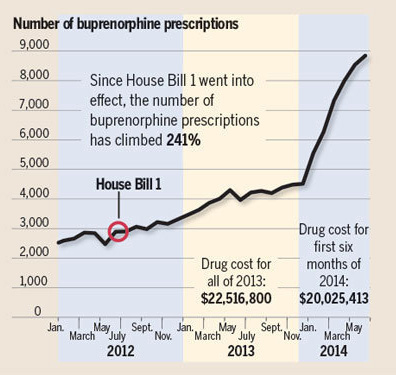
Read more here: http://www.kentucky.com/2015/06/20/3910362_the-drug-that-was-supposed-to.html?rh=1#storylink=cpy

Lexington Herald-Leader chart by Chris Ware from state data
Use of the drug in Kentucky "has increased 241 percent since 2012," Meehan reports. "And 80 percent of the prescriptions for it were being written by 20 percent of the state's 470 certified prescribers, said Dr. Allen Brenzel, medical director of the state's Department of Behavioral Health. . . . Since 2011, 10 doctors have been sanctioned by the Kentucky Board of Medical Licensure because of problems prescribing Suboxone."

Suboxone is supposed to be taken in conjunction with therapy and drug testing. "a patient receives a controlled dose of a legal drug as the dose is tapered by a physician for a safe and effective withdrawal," Meehan notes. However, "doctors started to see Suboxone patients on a cash basis, asking for as much as $300 for an office visit that included a prescription for the maximum allowable amount of Suboxone. Patients often received no therapy or drug testing. Some patients were on the maximum dose indefinitely, Brenzel said." Some doctors prescribed the drug with other painkillers, creating an illegal market.

To prevent such abuse by unscrupulous doctors, the medical-licensure board has issued regulations that require "more physician education and the requirement that the drug be prescribed only for medically supervised withdrawal and not be given to pregnant women," Meehan writes. "Patients should also be closely monitored and drug tested. If those rules are not followed, a doctor can face sanctions or restrictions to his medical license."

Suboxone was in the national news recently because the accused killer in the Charleston, S.C., shootings was arrested for illegal possession of it four months ago at a South Carolina shopping mall, the Herald-Leader notes.
Read more here: http://www.kentucky.com/2015/06/20/3910362_the-drug-that-was-supposed-to.html?rh=1#storylink=cpy

Read more here: http://www.kentucky.com/2015/06/20/3910362_the-drug-that-was-supposed-to.html?rh=1#storylink=cpy

Sunday, May 31, 2015

Paducah Sun looks at two local doctors who write many prescriptions for painkillers; such local data are easily available

The Paducah Sun has used some easily available information about two local doctors to shine a local light on their heavy prescribing of opioids.

The story by Laurel Black begins, "As narcotic painkiller abuse has drawn more public attention, two Paducah physicians  who have been ranked high among prescribers of such drugs  have found themselves defending their practices."

The story cites The Courier-Journal's analysis of 2012 Medicare data that showed Dr. Yogesh Malla of Paducah was "the No. 3 prescriber of narcotic painkillers in the commonwealth. A USA Today article listed Dr. Riley Love, also of Paducah, as 20th in the nation. Both reports used information the news organization ProPublica obtained under the Freedom of Information Act."

The Sun offers a quick retort from the medical director of the pain-management center where Malla practices, paraphrasung him as saying "the reports omit or minimize important factors, such as the specialty of the physicians and the morphine equivalence of the drugs they prescribe."


Dr. Laxmaiah Manchikanti also said in his written statement that his group emphasizes drugs with lower abuse potential and that more than 92 percent of patients at such centers "are already on long-term opioids; consequently, the best we can do (at these centers) is reduce the dosage."

Manchikani is CEO of the American Society of Interventional Pain Physicians, a lobbying group that advocates monitoring of painlkiller prescriptions, and a leading contributor to a wde range of political causes. The Sun doesn't note the latter point, but focuses on the issues of painkiller abuse, a major problem in Kentucky.

"With more than 1,000 deaths per year, Kentucky in 2013 had the third-highest drug overdose mortality rate in the United States, according to the Trust for America's Health," Black notes.


As for the other doctor, the Sun reports, "ProPublica's data on Love, who practices at the Lourdes Pain Management Center, reports that 59 percent of his 1,141 patients filled one or more prescriptions for a Schedule 2 drug and 51 percent filled for a Schedule 3 drug. Both figures are above the average of 45 percent and 41 percent, respectively, for his specialty in Kentucky.


"A spokeswoman for Love said Lourdes center represents the only location in the region where Medicaid patients receive inpatient pain consultations," the Sun reports, quoting her: "The patients we see are often very sick, and the treatments and medications we provide are the last resort comfort measures so the patients can spend quality time with family" as they near death.

The story is behind the Sun's paywall.

Sunday, May 24, 2015

State health commissioner backs needle exchanges, most controversial part of anti-heroin legislation passed this year

The Kentucky General Assembly cracked down in 2012 on "pill mills" that dispense painkillers irresponsibly, and addicts responded by going for heroin, creating a big problem in much of the state. The 2015 legislature passed laws to crack down on heroin, including local needle-exchange programs, the most controversial feature of the package.

In a column distributed to Kentucky newspapers, state Health Commissioner Stephanie Mayfield defends and promotes the local programs, which are subject to local approval.

“To some, a needle exchange may sound like a program that helps intravenous drug users feed their habit,” Mayfield writes. “To the contrary, the intent of an NEP is to protect public health and create a path for heroin users to get treatment while preventing the spread of diseases through the sharing of needles.

Needle exchanges reduce the number of HIV/AIDS and hepatitis cases in a community, Mayfield writes. "The use or even the accidental stick of a dirty needle can lead to hepatitis, HIV/AIDS infection and other dangerous diseases. . . . About 15 percent of all HIV cases that have occurred in Kentucky have been among injecting drug users."

Stephanie M. Gibson
Mayfield also says needle exchanges protecting people from accidental sticks from dirty needles discarded in public places. "Intravenous drug users submit dirty needles to the NEP for proper disposal in exchange for clean needles," she writes. "Researchers have also found that injecting drug users who participated in an exchange were more likely to reduce or stop injecting than drug users who had not participated in a needle exchange."

Research has also shown that needle exchanges "do not encourage the initiation of drug use nor do they increase the frequency of drug use among current users," Mayfield writes, noting that there are 203 such programs in 34 states.

"The presence of NEPs in communities does not expand drug-related networks nor does it increase crime rates. . . . Needle exchange programs actually create a path for injecting drug users to get help because the programs offer information on how to find available treatment options. In fact, NEP participants are more likely to enter a drug treatment program than nonparticipants."

More recent studies show that needle exchanges "provide opportunities for disease testing and education leading to a decline of at-risk behaviors, resulting in HIV incidence dropping as much as 80 percent within this population," Mayfield writes. "Many Kentucky communities are desperate for the ability to reach out to members who suffer from addiction, to help slow the spread of diseases and provide treatment referrals to people they might otherwise never have the chance to reach. This law gives them that opportunity."

Sunday, July 6, 2014

Drug developed to treat addiction is being abused, so much that clinics have been opened to sell it

"Suboxone, a popular and highly touted medicine designed to get people off opioids such as painkillers and heroin, is increasingly being abused, sold on the streets and inappropriately prescribed, according to doctors and drug control and law enforcement officials," Laura Ungar reports for The Courier-Journal. "The drug combines buprenorphine, an opioid, and naloxone, which counters the effects of an overdose. Prescriptions for Suboxone and its generic equivalent rose 63 percent in Kentucky between the first quarter of 2012 and the first quarter of this year, to 113,713 from 69,640."

One reason is the state's crackdown on pain clinics that were little more than pill mills. "In lieu of that, now people are opening Suboxone clinics. Many are cash-only," Leanne Diakov, general counsel for the Kentucky Board of Medical Licensure, told Ungar. "We have seen some doctors in trouble with licenses or finances opening these clinics." Ungar found that 14 percent, or 45, of the 330 Kentucky physicians authorized to prescribe buprenorphine "have a history of discipline by the medical board."

Attorney General Jack Conway told Ungar that suboxone abuse "is certainly on my radar, but I've kind of been careful to tread lightly. Some people desperately need Suboxone. I view it as a treatment of last resort . . . not a magic pill for addiction." Doctors told Ungar that some addicts self-medicate with Suboxone and use it to stave off withdrawal symptoms "when they have nowhere else to turn," she writes