Showing posts with label narcotics. Show all posts

Friday, June 26, 2015

Half again as many Kentucky newborns were hospitalized for drug dependency last year as the year before

Mother Samantha Adams and her newborn Leopoldo Bautista,
10 days old, spend quality time inside the Louisville Norton
Healthcare
child care center for children experiencing drug
withdrawal. (Photo by Alton Strupp, The Courier-Journal)
Increasing drug abuse drove up hospitalizations of drug-dependent newborns in Kentucky by 48 percent last year, to 1,409 from 955 in 2013. "The latest numbers represent a 50-fold increase from only 28 hospitalizations in 2000," reports Laura Ungar of The Courier-Journal.

"The seemingly never-ending increase every year is so frustrating to see," Van Ingram, executive director of the state Office of Drug Control Policy, told Ungar. "It's a horrible thing to spend the first days of your life in agony."

"These infants are born into suffering," Ungar writes. "They cry piercingly and often. They suffer vomiting, diarrhea, feeding difficulties, low-grade fevers, seizures — and even respiratory distress if they're born prematurely."

Drug-dependent newborns are becoming more common nationwide, Ungar notes, but "Vanderbilt University researchers publishing in the Journal of Perinatology [a subspecialty of obstetrics concerned with the care of the fetus and complicated, high-risk pregnancies] say rates are highest in a region encompassing Tennessee, Mississippi, Alabama and Kentucky."

While the increase is blamed mostly on illegal drug use, the Vanderbilt study found that 28 percent of pregnant Medicaid recipients in Tennessee filled at least one painkiller prescription, Ungar writes: "Legitimate use not only raises the risk of having a drug-dependent baby, it can sometimes lead to abuse and addiction."

While Medicaid now pays for behavioral-health and substance-abuse treatment, "Drug treatment for pregnant women is sorely lacking," Ungar reports. In Kentucky, only 71 of the 286 treatment facilities listed by the U.S. Substance Abuse and Mental Health Services Administration treat pregnant women. 

Sunday, June 21, 2015

Kentucky is cracking down on Suboxone, a heroin substitute that has become a big part of the illegal trade in painkillers

A drug that was supposed to help people get off heroin has "created a new cash-for-pills market and a street trade" that state officials are trying to stop, Mary Meehan reports for the Lexington Herald-Leader.

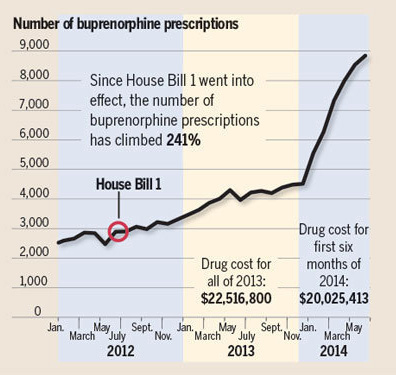
The drug is buprenorphine, the active ingredient in the brand-name drugs Suboxone and Subutex, which became more popular in 2012, when the state cracked down on "pill mills" that were freely handing out prescriptions for painkillers. "A lot of the pill mills morphed into facilities that dispense these prescriptions," Dr. John Langefeld, medical director for the state's Medicaid program, told Meehan.

Also, Meehan writes, the Patient Protection and Affordable Care Act required insurance plans to cover treatment for substance abuse, and "as more Medicaid patients and others got health-insurance coverage, more people obtained prescriptions for buprenorphine, Langefeld said. . . . According to a state report, one user obtained prescriptions from nine doctors."
Read more here: http://www.kentucky.com/2015/06/20/3910362_the-drug-that-was-supposed-to.html?rh=1#storylink=cpy

Lexington Herald-Leader chart by Chris Ware from state data
Use of the drug in Kentucky "has increased 241 percent since 2012," Meehan reports. "And 80 percent of the prescriptions for it were being written by 20 percent of the state's 470 certified prescribers, said Dr. Allen Brenzel, medical director of the state's Department of Behavioral Health. . . . Since 2011, 10 doctors have been sanctioned by the Kentucky Board of Medical Licensure because of problems prescribing Suboxone."

Suboxone is supposed to be taken in conjunction with therapy and drug testing. "a patient receives a controlled dose of a legal drug as the dose is tapered by a physician for a safe and effective withdrawal," Meehan notes. However, "doctors started to see Suboxone patients on a cash basis, asking for as much as $300 for an office visit that included a prescription for the maximum allowable amount of Suboxone. Patients often received no therapy or drug testing. Some patients were on the maximum dose indefinitely, Brenzel said." Some doctors prescribed the drug with other painkillers, creating an illegal market.

To prevent such abuse by unscrupulous doctors, the medical-licensure board has issued regulations that require "more physician education and the requirement that the drug be prescribed only for medically supervised withdrawal and not be given to pregnant women," Meehan writes. "Patients should also be closely monitored and drug tested. If those rules are not followed, a doctor can face sanctions or restrictions to his medical license."

Suboxone was in the national news recently because the accused killer in the Charleston, S.C., shootings was arrested for illegal possession of it four months ago at a South Carolina shopping mall, the Herald-Leader notes.
Read more here: http://www.kentucky.com/2015/06/20/3910362_the-drug-that-was-supposed-to.html?rh=1#storylink=cpy

Read more here: http://www.kentucky.com/2015/06/20/3910362_the-drug-that-was-supposed-to.html?rh=1#storylink=cpy

Saturday, June 20, 2015

Three doctors, nine others in western half of Kentucky are indicted in the largest-ever federal 'takedown' of Medicaid fraud

Former Dr. Fred Gott of Bowling Green was arrested.
(Photo: Miranda Pederson, Bowling Green Daily News)
Twelve people in the western half of Kentucky, including three doctors, have been charged with Medicaid fraud in what the federal government calls its biggest-ever "takedown" of the problem, Andrew Wolfson of The Courier-Journal reports.

The indictments allege "a half-dozen schemes involving nearly $8 million in alleged fraudulent billings," Wolfson writes. "The offenses include $5 million in false billings for muscle-relaxant injections that were never delivered to patients, as well as a staged car wreck in which three people allegedly conspired to get controlled substances and fraudulent reimbursements."

In another case, Wolfson reports, "a medical practice that treated car wreck patients is accused of using the DEA numbers of nurse practitioners to order hydrocodone for herself and falsely billing it to an insurance company. Nationally, the sweep resulted in charges against 243 people, including 46 doctors, nurses and other licensed medical professionals."

John Kuhn, acting U.S. attorney for the Western District of Kentucky, told Wolfson that about $1 billion of annual Medicare and Medicaid expenses are fraudulent. Medicare is the federal health-insurance program for people over 65; Medicaid is the federal-state program for the poor and disabled.

Former Dr. Fred Gott of Bowling Green, a 63-year-old cardiologist, was charged with "conspiracy to dispense controlled substances, health care fraud and money laundering," Deborah Highland reports for the Bowling Green Daily News. "The Bowling Green-Warren County Drug Task Force opened an investigation into Gott’s practices after Warren County Coroner Kevin Kirby alerted the task force about drug overdose deaths involving Gott’s patients, task force director Tommy Loving said."

Saturday, June 13, 2015

Seniors get a lot of anti-anxiety drugs, sometimes in dangerous combination with narcotics; Ky. ranks third in the nation in that

When Medicare's drug program, called Part D, was put into place more than a decade ago, Congress decided to not pay for anti-anxiety medications. In 2013, when Medicare started paying for them, the program went from spending nothing for these medications to paying more than $377 million, Charles Ornstein and Ryann Grochowski Jones report for ProPublica, a nonprofit, investigative news organization.

Using anti-anxiety drugs in combination with narcotics increases the risk of overdoses, but Kentucky has many doctors who prescribe a lot of both. More than 100 Kentucky doctors each wrote at least 1,000 prescriptions for both types of drugs in 2013, according to data compiled by ProPublica.

That ranked Kentucky third in the nation, trailing only Florida and Alabama. Other southeastern states dominated the top 10. California, the nation's most populous state, ranked eighth; Tennessee was fourth and Ohio was ninth.

ProPublica has an application that lets you look up, by doctors' names, cities or ZIP codes, the number of Medicare claims they filed in 2013, the amount of money, the number of patients and the number of prescriptions for brand-name drugs.

The anti-anxiety drugs, some known as benzodiazepines, include popular tranquilizers such as Valium, Xanax and Ativan. 

Lawmakers initially chose to keep them out of Medicare Part D because they had been linked to abuse and an increased risk of falls among the elderly. Doctors kept prescribing them to Medicare enrollees, who found other ways to pay for them.

In 2013, the year Medicare started covering benzodiazepines, it paid for nearly 40 million prescriptions, ProPublica found. Generic versions of Xanax (alprazolam), Ativan (lorazepam) and Klonopin (clonazepam) were among the top 32 most-prescribed medications in Medicare Part D that year.

The American Geriatrics Society "discourages the use of benzodiazepines in seniors for agitation, insomnia or delirium because they can be habit-forming and disorienting and their effects last longer in older patients." The society does say the drugs "are appropriate to treat seizure disorders, severe anxiety, withdrawal and in end-of-life care," ProPublica notes.

One geriatric psychiatrist told ProPublica that the drugs are a "very real safety concern" for the elderly, and that he and others in his field don't use them as a "first-, second-, or third- line of treatment." Some geriatric psychiatrists have voiced concerns that these drugs are now being used instead of antipsychotics, since Medicare has pushed to reduce the use of antipsychotics, particularly in nursing homes, because of their risks.

Several doctors who rank among Medicare's top prescribers of the drugs told ProPublica that any risks of anti-anxiety drugs are outweighed by their benefits. One said that the drugs worked well for his patients, many of whom were trying to kick addictions to narcotics, but struggled with anxiety and depression.

However, ProPublica also found that some doctors appear to be prescribing benzodiazepines and narcotic painkillers to the same patients, which increased the risk of misuse and overdose. That's where Kentucky ranked third.

Dr. Leonard J. Paulozzi, a medical epidemiologist at the federal Centers for Disease Control and Prevention, co-authored an analysis showing that benzodiazepines were involved in about 30 percent of the fatal narcotic overdoses that occurred nationwide in 2010, ProPublica reports.

Sunday, May 31, 2015

Paducah Sun looks at two local doctors who write many prescriptions for painkillers; such local data are easily available

The Paducah Sun has used some easily available information about two local doctors to shine a local light on their heavy prescribing of opioids.

The story by Laurel Black begins, "As narcotic painkiller abuse has drawn more public attention, two Paducah physicians  who have been ranked high among prescribers of such drugs  have found themselves defending their practices."

The story cites The Courier-Journal's analysis of 2012 Medicare data that showed Dr. Yogesh Malla of Paducah was "the No. 3 prescriber of narcotic painkillers in the commonwealth. A USA Today article listed Dr. Riley Love, also of Paducah, as 20th in the nation. Both reports used information the news organization ProPublica obtained under the Freedom of Information Act."

The Sun offers a quick retort from the medical director of the pain-management center where Malla practices, paraphrasung him as saying "the reports omit or minimize important factors, such as the specialty of the physicians and the morphine equivalence of the drugs they prescribe."


Dr. Laxmaiah Manchikanti also said in his written statement that his group emphasizes drugs with lower abuse potential and that more than 92 percent of patients at such centers "are already on long-term opioids; consequently, the best we can do (at these centers) is reduce the dosage."

Manchikani is CEO of the American Society of Interventional Pain Physicians, a lobbying group that advocates monitoring of painlkiller prescriptions, and a leading contributor to a wde range of political causes. The Sun doesn't note the latter point, but focuses on the issues of painkiller abuse, a major problem in Kentucky.

"With more than 1,000 deaths per year, Kentucky in 2013 had the third-highest drug overdose mortality rate in the United States, according to the Trust for America's Health," Black notes.


As for the other doctor, the Sun reports, "ProPublica's data on Love, who practices at the Lourdes Pain Management Center, reports that 59 percent of his 1,141 patients filled one or more prescriptions for a Schedule 2 drug and 51 percent filled for a Schedule 3 drug. Both figures are above the average of 45 percent and 41 percent, respectively, for his specialty in Kentucky.


"A spokeswoman for Love said Lourdes center represents the only location in the region where Medicaid patients receive inpatient pain consultations," the Sun reports, quoting her: "The patients we see are often very sick, and the treatments and medications we provide are the last resort comfort measures so the patients can spend quality time with family" as they near death.

The story is behind the Sun's paywall.