Showing posts with label health insurance. Show all posts

Saturday, July 4, 2015

Politicians, economists and journalists debate the reasons for, and the impact of, proposed sale of Humana to Aetna

By Al Cross
Kentucky Health News

The purchase of Louisville-based Humana Inc. by fellow health-insurance giant Aetna Inc. for $37 billion still needs approval from federal anti-trust officials, partly because of the possibility that the merger will reduce competition and increase premiums.

Some other public officials, the elected kind, wasted no time weighing in on the sale. And, since it deals with health insurance, it may come as no surprise that their statements followed partisan lines, reflecting their views of the Patient Protection and Affordable Care Act.

Wall Street Journal graphic
Even before the deal was announced, Senate Majority Leader Mitch McConnell, R-Ky., said Thursday, "You’ve seen the rumors about Humana being gobbled up by someone who’s even bigger. This kind of government takeover of the private health-insurance market – think of it this way: what Obamacare has basically done is taken the private health insurance market and turned it almost into a regulated utility."

In a press release Friday, McConnell said, "This morning’s announcement, as I predicted during the debate five years ago, is the inevitable result of Obamacare’s push toward consolidation as doctors, hospitals, and insurers merge in response to an ever-growing government."

U.S. Rep. John Yarmuth, D-Louisville, said consolidation in the health-care industry has been going on for decades, "and it is appropriate for the Department of Justice to scrutinize the pending merger to ensure it does not reduce competition, and therefore, consumers' options."

Louisville Mayor Greg Fischer, a Democrat who ran in the primary for McConnell's seat in 2008, said he was "a little surprised by the political nature" of the senator's statement. Fischer and Democratic Gov. Steve Beshear were generally upbeat about the merger. "I am cautiously optimistic that this merger will be a net positive for Louisville and the commonwealth," Beshear said.

Humana has 12,500 employees and 1,500 contractors in the Louisville area. Fischer said, "I think it's very fair to speculate that it will lead to more jobs," and Bruce Broussard, president and CEO of Humana, said, "I think Louisville will be a net beneficiary as a result of this transaction."

However, University of Louisville finance professor David Dubofsky "said it may not turn out so well for the Louisville and Humana employees after all," The Courier-Journal reports, quoting him: "When two companies in the same industry merge, and the acquirer is paying a premium, you have to generate cost savings," partly by reducing employment among workers with similar jobs.

There is a connection between the merger of health-care providers, such as the creation of Kentucky One Health by several hospital groups, and the merger of insurance companies. "Many experts have said that the provider consolidation can drive higher rates—and that more-powerful insurers might have a better chance of countering them and striking pacts for new forms of payment that incentivize efficiency," Anna Wilde Matthews and Christopher Weaver write for The Wall Street Journal.

But they also note, "Research suggests that having fewer insurers leads to higher premiums, said Leemore S. Dafny, a former Federal Trade Commission official who is a professor at Northwestern University’s Kellogg School of Management.

Aetna with Humana would dominate the Medicare Advantage market in some states, with 90 percent of it in Kansas, notes Drew Altman, president of the Kaiser Family Foundation. "Of course, regulators could insist that companies take steps to maintain more competitive markets."

The Journal reports that it analyzed a Medicare database and found, "An Aetna-Humana tie-up would increase by about 180 the number of U.S. counties where at least 75 percent of customers for Medicare Advantage plans are in the hands of a single insurer." Most of those counties are in the South and Midwest. Using another federal database, it found that "In eight states, an Aetna-Humana merger would remove a competitor from the exchanges where individuals can buy coverage under the Affordable Care Act."

The prospect that jobs might be lost in Louisville doesn't mean that the ACA has put financial pressure on Aetna or Humana, Dan Diamond writes for Forbes magazine: "There’s limited evidence that the biggest players are struggling. While the ACA capped insurers’ ability to take profits, industry analysts have been fairly bullish on the sector. . . . And as I wrote earlier this week, the ACA appears to have only helped major insurers, by driving millions of new customers into the market. Aetna and Humana have seen their stock valuations triple in the past five years, since the ACA was signed into law, and the other three major insurers also have seen huge gains."

Diamond also isn't buying the argument, advanced by Aetna officials, that the combined company will be more efficient than the separate ones. "Aetna and Humana already are giant, scaled entities," he notes. "And economists aren’t buying the claim that insurer consolidation will lead to lower costs." As Judy Woodruff noted on "PBS Newshour" Friday, the deal would give the combined company more leverage to negotiate payments to health-care providers.

Health insurers' shares of total Medicare Advantage business
(Kaiser Family Foundation chart)
Diamond says the best case for Aetna's purchase is that it gets the company deeply into the Medicare Advantage business, without having to expend "a great deal of work and time," as Michael Bernstein, a partner at Baird Capital partner who focuses on health care, told Bloomberg News last month. Aetna has only 7 percent of that business, Humana 19 percent -- and about 65 percent of its revenues came from Medicare Advantage plans in 2014, Altman notes. The combined company is expected to get 56 percent of its revenue from government programs.

Diamond says economists see one more possible reason for the merger: "Amid health care’s merger mania, insurers are feeling psychological pressure to make deals of their own." And that does take us back to Obamacare. But the impact on Kentucky has yet to be seen, and so do the reasons.

Friday, July 3, 2015

Ky.'s pro-Obamacare policies led to more enrollment and support for it, but many poor are still uninsured and under-informed

Update: This story was updated to reflect the study's results for those who said they were hurt  by and not directly impacted by the ACA. 

State policy appears to have a major impact on poor people's thinking about the Patient Protection and Affordable Care Act, as well as how they describe their experience with it, according to a Harvard University study published in the journal Health Affairs.

The study surveyed nearly 3,000 low-income residents in three Southern states that had varying approaches to the ACA and its implementation: "Kentucky, which expanded Medicaid, created a successful state marketplace, and supported outreach efforts; Arkansas, which enacted the private option and a federal-state partnership marketplace, but with legislative limitations on outreach; and Texas, which did not expand Medicaid and passed restrictions on navigators" who help people with the federal and state marketplaces.

The survey found that Kentucky, which has enrolled more than 500,000 people in Medicaid and another 109,000 in private health plans through the Kynect health-insurance exchange, had the highest success in application rates, successful enrollments and positive experiences with the ACA, followed by Arkansas and then Texas.

"This corresponds to the general pattern of state-level engagement and support for the ACA coverage expansions in these three states," the researchers write.

The study also found that limited awareness and poor information continue to be two of the greatest barriers to the ACA. Even in Kentucky, where awareness was the highest, only half of the poor people surveyed said they had heard "some" or "a lot" about the ACA's coverage options. About 10 percent of Kentuckians remain without health insurance.

Another barrier to applying for coverage was the perception that it would cost too much, but for those with incomes below 138 percent of poverty in states that have expanded Medicaid, coverage is available without having to pay a premium.

"This adds to previous evidence that information gaps about the law remain a major challenge, particularly among low-income populations who likely have the most to gain from the coverage expansions," the researchers write.

The study also found that application assistance from navigators and others was the strongest predictor of enrollment, increasing enrollment to 93.1 percent from 84.9 percent. Application assistance was most common in Kentucky (46.2 percent) and least common in Texas (31.9 percent). Navigators help consumers choose health-insurance plans to meet their needs and assist them with the application process.

Kentucky reported an overall better application experience than the other two states in the study, and had a significantly higher enrollment rate (92.4 percent) than Arkansas (87 percent) and Texas (84.8 percent).

The study found that advertising about the law didn't seem to affect whether people applied for coverage or enrolled in a plan. However, ads were strongly associated with perceptions of the law.

About 20 percent of respondents said they had read or heard more negative ads and approximately 12 percent recalled more positive ads, and two-thirds said ads were about equal. (Negative ads were most frequently reported in Arkansas, where Obamacare was an issue in a U.S. Senate race last year.)

Twice as many respondents felt that the ACA had helped them as hurt them, although the majority reported no direct impact. In Kentucky, 40 percent said it had helped them, 12 percent said it had hurt them and 48 percent said it had not impacted them directly;  In Arkansas, 30 percent said it had helped them, 17 percent said it had hurt them and 54 percent said it had not impacted them directly; and in Texas, 21 percent said it had helped them, 14 percent said it had hurt them and 66 percent said it had not directly impacted them.

"Nonetheless, 48 to 66 percent of low-income adults in all three states felt the law had not directly impacted them in 2014," the researchers wrote, "which suggests that the ACA has not yet reached many who might benefit from it."

Thursday, June 25, 2015

Supreme Court upholds Obamacare subsides in all states; ruling has no direct effect on Kentucky, but focuses political debate

By Molly Burchett
Kentucky Health News

The U.S. Supreme Court ruled Thursday that the tax subsidies provided under the Patient Protection and Affordable Care Act are legal in every state.

While the ruling has no effect on Kentucky, and would have had no direct effect if it had gone the other way, it sets the table for continued political debate about health policy in Congress and in Kentucky's race for governor.

"Congress passed the Affordable Care Act to improve health insurance markets, not to destroy them," Chief Justice John Roberts wrote in the 6-3 majority opinion. "If at all possible, we must interpret the Act in a way that is consistent with the former, and avoids the latter."

The law says the federal government can pay subsidies to help people afford insurance bought through “an Exchange established by the State.” The lawsuit argued that Americans in the 34 states using the federal exchanges were not eligible for the subsidies, which are crucial to the law's success, helping to make health insurance more affordable, reducing the number of uninsured Americans. Proponents of the law say not providing subsidies to individuals in those 34 states relying on the federal exchange would have upended the law, notes CNN.

President Obama called on critics to accept the law as permanent, saying after the ruling, "The Affordable Care Act is here to stay."

But Senate Majority Leader Mitch McConnell, R-Ky., called Obamacare “a rolling disaster for the American people,” with a “multitude of broken promises, including the one that resulted in millions of Americans losing the coverage they had and wanted to keep. Today’s ruling won’t change the skyrocketing costs in premiums, deductibles, and co-pays that have hit the middle class so hard over the last few years.”

Maps: Percentage uninsured in 2012, above, and 2014, below
Obama countered, "The setbacks I remember clearly. But as the dust has settled, there can be no doubt that this law is working. It has changed, and in some cases saved, American lives. It set this country on a smarter, stronger course." He added, "The law has helped hold the price of health care to its slowest growth in 50 years" and "Nearly one in three Americans who was uninsured a few years ago is insured today. The uninsured rate in America is the lowest since we began to keep records."

A White House fact sheet noted that the law also expanded "access to preventive care, including immunizations, well-child visits, certain cancer screenings, and contraceptive services, with no additional out-of-pocket costs as well as no more annual caps on essential benefit coverage and new annual limits on out-of-pocket costs."

Since Kentucky established its own exchange, Kynect, for buying subsidized health insurance or signing up for Medicaid, the ruling may seem moot for Kentuckians. However, it establishes some of the facts for a health-care policy debate in the governor's race between Republican Matt Bevin and Democratic Attorney General Jack Conway.

The exchanges and the expansion of the federal-state Medicaid program are choices for the states, and Bevin has said that if elected he would shut down Kynect and end the Medicaid expansion, which has covered about 430,000 Kentuckians. The federal government is paying their entire cost through next year; in 2017 the state would start picking up a small share, rising to the law's limit of 10 percent in 2020.

Conway has acknowledged questions about whether the state can afford to pay its share, but to “say you’re going to kick a half a million people off of health insurance based on what we may or may not be able to afford in 2021 is irresponsible.” A Conway spokesman said he "appreciates the court's careful consideration of this case and agrees with today's decision," reports the Lexington Herald-Leader.

The Herald-Leader's Mary Meehan interviewed officials and experts for a package of questions and answers about the law and Kentucky. It is published at http://www.kentucky.com/2015/06/25/3917832_in-light-of-the-supreme-court.html.

Outgoing Gov. Steve Beshear, a Democrat who expanded Medicaid, said in a statement that the decision “reaffirms that, from the very start, we did the right thing for the more than 500,000 Kentuckians who have qualified for health-care coverage through Kynect since January 1, 2014.”

Susan Zepeda, president and CEO of the Foundation for a Healthy Kentucky, said in a release, "While many have been awaiting this important decision, we must remember that much remains to be done to assure that all Kentuckians – and all Americans – have timely access to safe, effective and affordable quality care." Zepeda said Kentuckians continue to work on ways to improve and protect Kentuckians' health, such as reforming the way we pay for care and making health care cost and pricing more transparent.

"As people who have forgone care too long because of its expense now gain access to care, it will place a larger short-term burden on the health-care system, which approaches like these can help to address," said Zepeda. "The Affordable Care Act permits – and incentivizes – local health care innovation. We can and must shape Kentucky solutions to Kentucky’s health challenges."

Aetna is close to a deal to buy Humana, Bloomberg reports

Getty Images, via CNBC
Health insurer Aetna "is said to be closing in on a deal to buy" Louisville-based Humana Inc., Julie Hyman reports for Bloomberg News, "and a deal could come "as soon as this weekend."

Humana is also expecting an offer from Cigna Inc., but Humana's board of directors "prefers the Aetna offer," Hyman reports, citing unnamed people familiar with the negotiations. The deal has been discussed for weeks, but Aetna didn't make a formal proposal until this week.

The last major obstacle to a deal may have been the Supreme Court's ruling today that people in all states are entitled to tax subsidies for health insurance under the Patient Protection and Affordable Care Act, Hyman suggests, noting higher stock prices for health-insurance companies.

"Shares of Humana rallied more than 8 percent after trading was briefly halted for volatility," Reem Nasr of CNBC reports.

Humana is an attractive buy because "a great deal of its business — 73 percent of its premiums revenue — comes from contracts with the federal government," David Mann reports for Louisville Business First. "That means Humana is flush with Medicare business, which is a fast-growing category in the industry as many baby boomers are reaching the eligibility age. Its competitors, including Aetna, don't have nearly as much of this business."

"Consolidation among the country's top insurers follows a massive consolidation among providers in pharmacy, hospital and patient care, which has increased the leverage against insurers like Humana and Aetna," Grace Schneider reports for The Courier-Journal.

Sunday, June 21, 2015

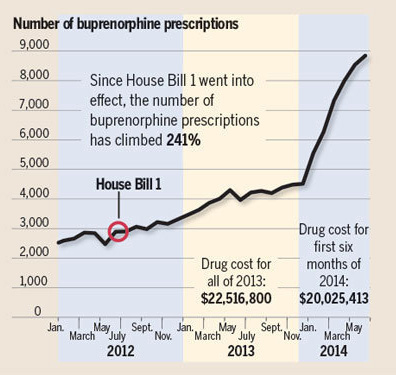
Kentucky is cracking down on Suboxone, a heroin substitute that has become a big part of the illegal trade in painkillers

A drug that was supposed to help people get off heroin has "created a new cash-for-pills market and a street trade" that state officials are trying to stop, Mary Meehan reports for the Lexington Herald-Leader.

The drug is buprenorphine, the active ingredient in the brand-name drugs Suboxone and Subutex, which became more popular in 2012, when the state cracked down on "pill mills" that were freely handing out prescriptions for painkillers. "A lot of the pill mills morphed into facilities that dispense these prescriptions," Dr. John Langefeld, medical director for the state's Medicaid program, told Meehan.

Also, Meehan writes, the Patient Protection and Affordable Care Act required insurance plans to cover treatment for substance abuse, and "as more Medicaid patients and others got health-insurance coverage, more people obtained prescriptions for buprenorphine, Langefeld said. . . . According to a state report, one user obtained prescriptions from nine doctors."
Read more here: http://www.kentucky.com/2015/06/20/3910362_the-drug-that-was-supposed-to.html?rh=1#storylink=cpy

Lexington Herald-Leader chart by Chris Ware from state data
Use of the drug in Kentucky "has increased 241 percent since 2012," Meehan reports. "And 80 percent of the prescriptions for it were being written by 20 percent of the state's 470 certified prescribers, said Dr. Allen Brenzel, medical director of the state's Department of Behavioral Health. . . . Since 2011, 10 doctors have been sanctioned by the Kentucky Board of Medical Licensure because of problems prescribing Suboxone."

Suboxone is supposed to be taken in conjunction with therapy and drug testing. "a patient receives a controlled dose of a legal drug as the dose is tapered by a physician for a safe and effective withdrawal," Meehan notes. However, "doctors started to see Suboxone patients on a cash basis, asking for as much as $300 for an office visit that included a prescription for the maximum allowable amount of Suboxone. Patients often received no therapy or drug testing. Some patients were on the maximum dose indefinitely, Brenzel said." Some doctors prescribed the drug with other painkillers, creating an illegal market.

To prevent such abuse by unscrupulous doctors, the medical-licensure board has issued regulations that require "more physician education and the requirement that the drug be prescribed only for medically supervised withdrawal and not be given to pregnant women," Meehan writes. "Patients should also be closely monitored and drug tested. If those rules are not followed, a doctor can face sanctions or restrictions to his medical license."

Suboxone was in the national news recently because the accused killer in the Charleston, S.C., shootings was arrested for illegal possession of it four months ago at a South Carolina shopping mall, the Herald-Leader notes.
Read more here: http://www.kentucky.com/2015/06/20/3910362_the-drug-that-was-supposed-to.html?rh=1#storylink=cpy

Read more here: http://www.kentucky.com/2015/06/20/3910362_the-drug-that-was-supposed-to.html?rh=1#storylink=cpy

Saturday, June 20, 2015

Merger mania: Aetna bids for Humana; Cigna may want it too; Anthem has bid for Cigna; UnitedHealth makes a play for Aetna

Aetna Inc. has made a bid to buy Louisville-based Humana Inc.,"one of a number of recent moves by big health insurers to find merger partners," Dana Mattioli and Liz Hoffman report for The Wall Street Journal.

The proposal was made in "the last few days," the Journal reports. "It isn’t clear how much Aetna indicated it would pay. Humana has a market value of $30 billion. The company hired Goldman Sachs Group Inc. to help it field takeover interest, people familiar with the matter have said."

Meanwhile, Aetna has been approached by another big insurer, UnitedHealth Group. "It isn’t clear what, if any, Aetna’s response was," the Journal reports. "News of the Aetna proposal comes the same day Anthem Inc., another of the five big managed-care companies, said it boosted its takeover offer for Cigna Corp.,"offering $47.5 billion. "Anthem went public with the bid after the two sides failed to reach agreement, and is seeking to put pressure on Cigna through Cigna shareholders."

"Cigna itself is eyeing Humana, people familiar with the matter have said. The five big managed-care companies are jockeying for deals that will enable them to get more efficient and better respond to changes in the health care landscape in the U.S.," the Journal reports.

"Humana, which has an estimated 12,000 employees and roughly 2,000 contractors in Louisville and the immediate region, has been seen as an attractive target in the health-insurance industry because of its well-run business running Medicare Advantage programs," Grace Schneider reports for The Courier-Journal. The company is valued at $30 billion.

"The company's membership rolls have surged to more than 3 million in the last year," Schneider writes. "That growth comes when health care reform has forced providers — hospitals, doctors, pharmacies, among them — to consolidate to increase their leverage and clout in an increasingly competitive health care segment. For the same reason, health insurers are now looking to consolidate."

Friday, June 19, 2015

Republican legislators question cabinet's figures on managed-care payments and cost projections for Medicaid expansion

Audrey Haynes (cn|2 image)
"When Audrey Haynes sat down before the legislature’s Medicaid Oversight and Advisory Committee Wednesday, she expected the data she brought would persuade lawmakers that Kentucky’s expansion of Medicaid has been good for the state," Ronnie Ellis reports for CNHI News Service. "The secretary of the Cabinet for Health and Family Services, which administers the Medicaid program also may have expected her statistics to ease unhappiness with the state’s move to managed care for most Medicaid services."

"It didn’t happen," Ellis writes. "At least she didn’t persuade Republican members who openly questioned the validity of the cabinet’s data, a couple stopping just short of saying the cabinet is making up the numbers" about payments to providers by managed-care organizations, which it says are 99 percent on time. “The numbers do not appear to represent the reality on the ground,” Rep. Richard Benvenuti, R-Lexington, said after the meeting.

Sen. Ralph Alvarado
“I think those are false,” Sen. Ralph Alvarado, R-Winchester, said after the meeting. “I don’t know if they’re lying, but somebody is providing bad information.”

During the meeting, Alvarado read "segments of letters from providers who have not received full reimbursements from managed care organizations," reports Kevin Wheatley of cable channel cn|2's "Pure Politics."

"Haynes referenced a report from CHFS which showed that over 90 percent of Medicaid claims are being paid in a timely manner," reports the blog of the Kentucky Chamber of Commerce. "Sen. Alvarado replied that this statistic does not match what he is hearing from his constituents and medical providers." Haynes addressed the managed-care issue in her PowerPoint presentation, downloadable here.

Rep. David Watkins, D-Henderson, a retired physician and co-chair of the committee, "urged the panel to find ways to improve managed care."

Watkins said the managed-care organizations, which are insurance companies or their subsidiaries, should come before the committee to answer questions. “I’m not totally satisfied that they’re doing quite as good a job as your report here would portray,” he told Haynes. “I think they need to be more accountable. I think they need to be more responsive to the providers who actually are doing work in the field.”

The MCOs will appear before the joint House-Senate committee Aug. 19, Brad Bowman reports for The State Journal in Frankfort. For cn|2's three-minute clip of the discussion between Haynes and Alvarado, via YouTube, click here.

The Republican lawmakers also voiced skepticism, but offered no contrary evidence, about the cost of expanding Medicaid to households with incomes up to 138 percent of the federal poverty level, from the previous limit of 69 percent. Under the Patient Protection and Affordable Care Act, the federal government is paying the entire cost of the expansion until next year, when the state will begin paying a small part, rising to the law's cap of 10 percent in 2020.

Haynes noted projections for Democratic Gov. Steve Beshear's administration that the expansion would add $30.1 billion to the state's economy through 2021, and would pay for itself until then, even after the state starts picking up part of the cost. The numbers were not new; they were part of a study by Deloitte Consulting and the University of Louisville that Beshear released in February.

Republicans focused on the prediction that the expansion would cost the state a net $45 million in 2021. "I know that seems like a way long ways off and some of you may no longer even be in the position to deal with it, but some of us probably will and the taxpayers will," said Alvarado, a physician.

Haynes "stated that she believed with the financial boost to the economy through jobs, the costs will be offset," the blog of the Kentucky Chamber of Commerce reports.

“Now that we’re seeing the lowest unemployment that we’ve seen in our state in quite a number of years, I’m sure each of you are amazed at how that we’ve had all 120 counties in our state where the unemployment rate has gone down,” Haynes said. “As this state continues to generate revenue and hopefully, as is planned, this is a bridge program for people who basically are hard-working people, but their employer does not provide insurance or they have children and therefore that qualifies them from an income basis for Medicaid.”


Thursday, June 11, 2015

Bevin says he will end all Obamacare programs in Ky., including Medicaid expansion that has added more than 400,000 to rolls

Matt Bevin, the Republican nominee for governor, has made clear that if elected he would end the Medicaid expansion that has provided free health coverage for more than 400,000 poor Kentuckians.

During his primary campaign, Bevin never made that quite plain, saying he would close the state's health-insurance exchange, Kynect, because it would cost "hundreds of millions of dollars." Kynect is paid for by insurance companies, so Bevin was alluding to to the state's projected cost of expanding Medicaid, which enrolls through Kynect.

The Washington-based publication Politico reported on June 10, after interviewing Bevin, that he would not only close Kynect but roll back the Medicaid expansion: “You may or may not have access to Medicaid going forward,” he said. “People are not on it for extended periods of time. It’s not meant to be a lifestyle. It really isn’t. The point of it is to provide for those who truly have need.”

Democratic nominee and Attorney General Jack Conway, with Gov.
Steve Beshear; GOP nominee Matt Bevin (AP photos via Politico)
Gov. Steve Beshear "is furious" about Bevin's plan, Politico reported. “I am not going to allow someone to become governor of this state who wants to take us back to the 19th century,” the governor said in a telephone interview. “For a serious candidate for governor to be advocating a simple repeal of the whole program without offering any kind of alternative which will continue health care for these people is irresponsible.”

Beshear expanded the eligibility rules for Medicaid as part of implementing the Patient Protection and Affordable Care Act, raising the income limit to the law's required 138 percent of the federal poverty level, from the state's previous level of 69 percent.

The federal government is paying the entire cost of the newly eligible Medicaid recipients though next year. In 2017, the state would begin to pay 3 percent, rising to the reform law's cap of 10 percent by 2020. A study by Deloitte Consulting and the Urban Institute at the University of Louisville  — "which Republican critics have rejected as spin," Politico says — has said the expansion more than pays for itself through 2020 by expanding health-care jobs and generating tax revenue.

Jobs are growing as projected by the study, according to the Cabinet for Health and Family Services, which handles Medicaid.

Cabinet spokeswomnan Jill Midkiff said the study estimated that 32,000 jobs would be created through 2015 as a result of the expansion. "U of L projected this growth would primarily be in the areas of retail trade, finance and insurance, administrative services, health and social services, accommodations and food services and other services," Midkiff said. "These sectors were estimated to account for more than 28,000 of the 32,000 jobs created." She said the latest Bureau of Labor Statistics figures show that "these sectors have grown by more than 29,000 jobs from 2013 until April 2015. Therefore, the most recent BLS numbers indicate that UofL’s estimates are on target to meet projections."

Politico says a Bevin victory could "blot an Obamacare bright spot," since Kynect has "worked virtually glitch-free." Through April, 106,000 Kentuckians had obtained tax-subsidized, private insurance coverage through Kynect, which is also the portal for enrolling in Medicaid.

Bevin says he would move those people to the federal exchange, which has been marred by technological issues and charges insurance companies much more to use it than Kynect does. But that plan would not work if the U.S. Supreme Court rules this month that the tax subsidies are not legally available through the federal exchange.

"That doesn’t worry Bevin," Politico reports, quoting him: “You’re worrying about a hypothesis. Let’s let the Supreme Court rule.”

And what about the new Medicaid recipients who would lose their benefits if Bevin wins? He "insists that Obamacare is coverage in name only — that Kentuckians still lack access to high-quality health care, partly because Medicaid pays doctors such low rates, partly because he says too many people rely on emergency rooms," Politico reports, quoting him: “Just having health insurance doesn’t mean you’re going to get health care.”

Attorney General Jack Conway, the Democratic nominee, declined Politico's request for an interview. Campaign spokesman Daniel Kemp said, “Jack wants to make sure that the hundreds of thousands of Kentuckians who now have health insurance through Kynect, especially kids, keep their health insurance — not play politics or push an ideology that’s out of touch with Kentucky’s values.”

Politico observes, "Conway is in the tricky spot of embracing Kynect while trying to keep his distance from Obama and Obamacare, a term that still generates ire among Kentucky residents. A September 2014 Marist [College] poll found that 61 percent of registered Kentucky voters had an unfavorable impression of Obamacare. Only 17 percent had negative feelings about Kynect."

Friday, June 5, 2015

Citing costs, Bevin has said he would shut down Kynect; actually, insurance companies pay for it; Medicaid is another matter

By Molly Burchett and Al Cross
Kentucky Health News

The governor's race between Democrat Jack Conway and Republican Matt Bevin will spotlight the Patient Protection and Affordable Care Act, an issue that affects all Kentuckians at least indirectly.

Conway, in his eighth year as attorney general, says he would have voted for the law. Bevin, who was the most conservative candidate in his primary, has said he would shut down the state's health-insurance exchange, Kynect, that was established under the law, because it will cost the state hundreds of millions of dollars.

Actually, Kynect is paid for by insurance companies that sell policies in Kentucky. Bevin appears to be referring to the projected cost of expanding Medicaid, another Obamacare-related move that Democratic Gov. Steve Beshear made at the same time he created Kynect. It raised the program's income limit to 138 percent of the federal poverty level, from 69 percent.

The federal government is paying the entire cost of the Medicaid expansion for the first three years. In 2017, the state will pay 3 percent, gradually rising to the law's cap of 10 percent in 2020. A study for the state projects that the expansion will pay for itself until 2021 by expanding health-care jobs and generating economic activity and tax revenue.

Bevin has scoffed at those projections. Conway has said the state needs to provide health coverage, but only what it can afford.

As Kentuckians, voters, and consumers of health insurance, you may be asking: What's going on with Obamacare in the state? Are we able to afford it? Who and what should we believe? While the cost of Medicaid expansion is debatable, it's becoming clear that Kynect has avoided the problems plaguing other state-run exchanges.

So far, the Centers for Medicare and Medicaid Services has dispensed more than $4.9 billion in grants to help launch state-run exchanges. Kentucky received $253 million for the initial planning and development phases of Kynect. Now its $28 million annual cost is covered by a fee on insurance companies, state officials say.

Despite federal support and their own revenue sources, many of the 17 state-based exchanges are expecting deficits this year and in the future. Many will continue to rely on leftover federal funds to pay for operations this year, report Darius Tahir and Paul Demko of Modern Healthcare. Hawaii announced this week that it would close its exchange and transfer clients to the federal exchange because of continued funding problems.
Kynect officials say it isn't having such problems because the state has ensured that Kynect is self-supporting through fees on insurance plans.

"The governor committed that the exchange would be self-supporting and would not rely on state General Fund dollars," said Jill Midkiff, spokeswoman for the Cabinet for Health and Family Services. "Kentucky’s sustainability plan employs an existing assessment on insurers that was previously used to fund Kentucky Access, the state’s high-risk pool, which was closed [since] individuals previously enrolled are now eligible to purchase a plan through Kynect."

But to transform Kentucky Access into Kynect, Beshear used executive orders that bypassed the General Assembly, where Republicans control the Senate. They have questioned his use of executive powers but generally have not been critical of Kynect.

The fee on insurers is a 1 percent, broad-based assessment on companies offering plans through the exchange. While insurers don't pass this fee directly to consumers, it almost certainly figures into their calculation of premium calculation and thus is indirectly paid by policyholders. The federal exchange is financed in a similar way, but its fee is 3.5 percent, meaning higher costs for insurers and policyholders.

In most cases, premiums for Kynect policies are reduced by a federal income-tax subsidy that is a key part of Obamacare.

"The vast majority of Kentuckians buying health insurance through Kynect are eligible for some kind of payment assistance or subsidy," Beshear said in commenting on most health-insurance companies recent requests for premium increases. "That cost will vary from family to family, so talking about rate changes in a vacuum isn’t a very effective way to gauge how much those rate fluctuations may affect policyholders or those shopping for insurance."

Bevin says he would move Kynect customers to the federal exchange, but the U.S. Supreme Court could rule this month that the tax subsidies are not supposed to be available through the federal exchange. The plaintiffs in the case cite a passage of the law that opponents say was a drafting error and does not make sense when the law is viewed as a whole.

If the court agrees with the plaintiffs, and Congress doesn't change the law, states using the federal exchanges will see spikes in insurance premiums, and millions of people could be at risk of losing their insurance. Bevin has not said what he would do in case of such a ruling.

Independent Drew Curtis is also running for governor.

Wednesday, June 3, 2015

Most insured through Kynect will pay more in 2016; Kentucky Health Cooperative seeks 25 percent increase

By Molly Burchett
Kentucky Health News

The federal health law requires that insurers planning to significantly increase premiums for policies on a health-insurance exchange to submit their rates by June 1 for review. Many insurance carriers across the country, including four in Kentucky, are requesting double-digit increases in insurance premiums for 2016.

For the individual market, the requested average rates from companies already participating in the Kynect exchange are:
  • Anthem Health Plans, 14.6 percent increase;
  • CareSource Kentucky, 11.8 percent increase;
  • Humana Inc., 5.2 percent increase;
  • Kentucky Health Cooperative, 25.1 percent increase;
  • WellCare Health Plans, a 9.28 percent decrease.
The rates are not final, but are subject to approval by the state Department of Insurance, "so we don’t yet know what the final numbers will be," Gov. Steve Beshear said. "Changes still may occur. Rates should be finalized sometime in mid-July. We do expect that some plan rates will go down, some will go up and some will stay close to the same as last year."

Consumers will have more choices when enrollment opens, because the exchange is adding three new insurers to its individual market. United Healthcare will be offering coverage statewide, Aetna policies will be available in 10 counties, and Baptist Health Plan, now Bluegrass Family Health, will offer coverage in 79 counties. CareSource will expand its coverage area from 16 to 67 counties.

With these additions, at least three insurers will be offering Kynect coverage in every county, said Ronda Sloan of the Department of Insurance.

"When open enrollment begins this fall, Kentuckians should seek information about their individual plans, not average costs," Beshear said. "System-wide averages don’t give a good picture of what an individual’s out-of-pocket costs may be."

It is also important to keep in mind that premiums cannot be viewed in isolation, and you should look at the individual market dynamics that impact how much consumers pay for their health care coverage.

Why are most rates going up?

For an insurance company to survive, its cost of providing benefits should be less than the premiumums paid for those benefits. Companies now have had more than a full year of claims data to inform pricing structures, and many insurers are finding that people who buy policies on exchanges are considerably older and sicker than anticipated, reports Megan McArdle of Bloomberg News.

As a result, insurers are incurring greater costs of providing benefits than expected. Initially, the U.S. Department of Health and Human Services said that about 40 percent of the exchange policies should be bought by people between 18 and 35, the most healthy age group, to keep the exchanges financially stable. However, according to HHS data, that group accounted for only 28 percent of the policies in 2014 and 2015.

Not only do older people have more complex and more costly health needs, rising premiums in some state-based exchanges are due in part to the uncertainty in the overall health-insurance marketplace. First, there is much uncertainly about the reform law's "risk corridor program," which was designed to have insurers share the financial risk of offering policies on Obamacare exchanges from 2014 through 2016.

The program creates a pool of money to reduce risk for insurers: Those that pay out less in benefits than they collect in premiums pay into the pool; those whose premiums don't cover the cost of providing benefits take money from the pool. However, a recent Standard & Poor's report says the risk corridor will probably not get enough money from insurers with profitable exchange plans, so many insurers must raise premiums to support themselves.

Kentucky Health Cooperative needs shoring up

In another potentially worrisome sign, some insurers had risk-corridor receivables that exceeded half of their reported capital, and Kentucky Health Cooperative had the second-highest level of receivables as a percentage of capital: 117 percent, reports CNBC. That helps explain why it has asked for the largest average increase in premiums this year, 25 percent, and last year, 20 percent. The cooperative is one of several start-ups funded by the reform law to encourage competition in states; it sells most of the 106,000 private policies on Kynect.

Other reasons for the overall premium increases include rising health-care costs, especially for prescription drugs, Larry Levitt, senior vice president of the Kaiser Family Foundation, said on "PBS NewsHour" Wednesday night.

Speaking nationally, Levitt said state regulation means the requested premiums "will come down, in some cases by a lot." He said "Insurers are jockeying for position in these new marketplaces [so] there are some good deals to be had, but consumers really have to look around,"

David Blumenthal, president of The Commonwealth Fund, which researches health and social policy, said exchanges like Kynect "give people the ability to comparison-shop much more easily than before."

Wednesday, May 27, 2015

Beshear is Communicator of the Year for efforts with Kynect

Governor Steve Beshear ​has been named 2014 Communicator of the Year by ​the Public Relations Society of America's Thoroughbred chapter.

He received the award for his communication to Kentucky residents about Kynect, the state's online healthcare marketplace created under federal health-care reform.

More than half a million Kentuckians have gotten coverage through Kynect, most of them through Medicaid, which Beshear expanded under the federal law.

Wednesday, May 20, 2015

Regan Hunt, executive director of Kentucky Voices for Health, leaves for a new position at insurer Humana Inc.

The executive director of Kentucky Voices for Health, a group that worked for the implementation of the Patient Protection and Affordable Care Act, is now working for Humana Inc. as a product development consultant.

Regan Hunt
Regan Hunt switched jobs after working in a way that won her the Consumer Health Advocate of the Year Award by Families USA, which cited her work for expansion of Medicaid in Kentucky and her efforts to increase health coverage under the Affordable Care Act. In her new job, she will be a product development consultant, working on design of benefits for those covered by the Medicaid expansion.

During her time at KVH, Hunt worked with a coalition of more than 200 partners to address the many health care needs of Kentuckians, including access, prevention, quality and value. Hunt said in an interview that she was most proud of  KVH's role in enrolling so many Kentuckians in coverage during 2013-15.

"Kentucky is one of those states that did it right," she said.

Hunt said that she was also proud of the group's collaboration between Gov. Steve Beshear, the state Cabinet for Health and Family Services: "We all worked together and that was an amazing thing ... all working together to make sure that people got the information that they needed and got covered. ... It was a once-in-a-lifetime sort of thing." KVH is not a lobbying group, but many of its members are.

At Humana, Hunt will research the Medicaid expansion landscape in other states to determine what new beneficiaries that population might need or want in a benefits package, beyond what is required by law.

"I am an advocate, probably until the day I die," she said, noting that she will now work as an individual advocate, instead of under the umbrella of KVH, to help people gain access to health coverage. "I've been doing that since I was 22, so it is not something that I am going to give up doing."

Hunt is a native of Pike County, She earned her undergraduate degree at Transylvania University and her Masters in Public Administration degree from the University of Kentucky. She also holds a certificate in health-care management from the University of North Carolina, according to the KVH website.

Sunday, May 17, 2015

Lexington Herald-Leader says Kentucky Hospital Association report on members' finances damages the group's credibility

The Kentucky Hospital Association's recent "Code Blue" report on its members' finances is a symptom of "financial hypochondria," the Lexington Herald-Leader said in a long editorial Sunday. It said the title, "signaling a patient needs resuscitation, is an unintentionally fitting title because the KHA's credibility could use a little CPR."

Read more here: http://www.kentucky.com/2015/05/17/3855678/hospitals-suffering-financial.html#storylink=cpy

The report "voices a universal human desire: more money, less accountability. The association implies that federal financial penalties aimed at reducing harm to patients are too onerous for hospitals that care for Kentuckians," the editorial says. "Little more than anecdotes are offered with no acknowledgment that some Kentucky hospitals are recording record bottom lines and steep drops in uncompensated care."

The newspaper offered its own anecdote, a large one, noting that the University of Kentucky's medical center is a major beneficiary of the Medicaid expansion under federal health reform: "The 2014 period saw an 83 percent drop in non-paying inpatients, a 66 percent drop in non-paying outpatients and a $60 million increase in Medicaid revenue. UK Healthcare's annual net income through March is up $70 million over the same time last year. Not all of that increase is due to the Medicaid expansion or Kynect," the state exchange for enrolling in Medicaid or buying private insurance.

"The important point," the paper says, is that "Slowing down spending on hospital care is one of the best things we can do for the economy and our health. The United States spends the highest percentage of its GDP on health care of any country but gets worse outcomes. Even by U.S. standards, Kentuckians over-utilize hospital care."

Read more here: http://www.kentucky.com/2015/05/17/3855678/hospitals-suffering-financial.html#storylink=cpy

Friday, May 15, 2015

3,047 got private health insurance in special March-April signup designed to avoid or reduce tax penalty for not being covered

More than 3,000 Kentuckians signed up for health coverage during a special March-April enrollment period that allowed them to avoid or reduce tax penalties for being uninsured.

"At the Feb. 15 close of the 2015 open enrollment period, 158,685 individuals had enrolled in health care coverage through Kynect for 2015," a state press release said. "That number included 102,830 Kentuckians who have either newly enrolled in a qualified health plan since Nov. 15, 2014, or renewed the private insurance plan they purchased through Kynect last year."

With the additional 3,047 enrollments, the final enrollment in private health insurance was 105,877. The federal tax penalty for being uninsured in 2014 was $95 for each adult household member or 1 percent of income, whichever is greater. In 2015, it will be $325 for each adult or two percent of income, whichever is greater. Penalties for not insuring children are half those for adults.

“Given that the personal risks of not having health coverage are even greater than the penalties, we decided to continue a special enrollment period to allow those individuals more time to sign up,” Gov. Steve Beshear said in the release.

Those who took advantage of the special enrollment period will still owe a penalty for any months they were uninsured and did not qualify for an exemption in 2014 and 2015. "This special enrollment period was designed to allow such individuals the opportunity to get covered for the remainder of the year and avoid additional fees for 2015," the release said.

Friday, May 1, 2015

Kynect has an app for smartphones

Kentucky's state health benefits exchange, Kynect, is offering a free mobile app that will provide "on-the-go" access to the health-insurance marketplace.

The  smartphone app will allow you to log in to your account, browse plans, report changes in your circumstances, take photos of required verification documents and upload those photos directly to your account.

It can also help determine if you qualify for low-cost or free health coverage, get information about your coverage options, find out enrollment dates and learn how certain life events can qualify you to enroll now.

It allows you to log in to your Kentucky Online Gateway Account, look at the status of your health care plan or application, get more information about your current health care plan, access alerts, notifications or messages related to your account and view and update contact information.

And if you have further questions, it can connect you to an insurance agent or nearby "Kynector."

The app is available for download in the iTunes Store for Apple devices or in the Google Play Store for Android users.

Friday, April 24, 2015

Southern Kentucky physician expands his in-school clinics; already in Russell County, will be in Adair County next year

Dr. Eric Loy
(Columbia Magazine photo)
An entrepreneurial physician in Southern Kentucky has developed a way to deliver school health services that could have a broader impact on communities.

Cumberland Family Medical, based in Burkesville, has clinics at the five schools in Russell County and now has a deal to do likewise with the four in adjoining Adair County.

Dr. Eric Loy, who owns the clinic, "said that the agreement could have an important impact on the community both short term, by helping create a healthier and more focused student body; and long term, by creating a culture where people get acclimated to seeing doctors and nurses for physicals and regular checkups on a consistent basis," Wes Feese reports for The Adair Progress.

“We have a chance to change the culture of health care in Kentucky,” Loy told the Adair County Board of Education, which voted to spend $80,000 next year on the clinics. That is "roughly the same cost the district currently pays for school nurses," Feese reports. "If the trial run next year is successful, both parties will have options to continue the agreement."

"Cumberland Family Medical will pay two-thirds of the nurse expense and will bill the insurance of the patient," Toni Humphress reports for the Adair County Community Voice.

School Supt. Alan Reed complimented the dedication and service of the county’s school nurses but said costs to employ them were “soaring,” Feese reports. Reed said of Loy's plan, “This is kind of a novel approach, and from all we’ve seen, we really like it. It cuts down on time and any barriers for a kid getting health care.”

Loy agreed, saying, “A lot of times that’s the barrier, that it’s hard [for parents] to miss work.”

School principals said sick students may have to sit in an office or lobby all day because working parents are unavailable to come pick the students up and take them to a doctor. "Director of Pupil Personnel Robbie Harmon said that this move could have a bigger long-term impact on the community than any project he’s worked on in his time in the school system."

Loy's in-school clinics are manned by a full-time nurse practitioner who travels between schools, and is overseen by a physician. "Loy said that all forms of insurance would be accepted, and that all children would be seen and treated, regardless of their ability to pay," Feese reports. "He also said that the clinics could help out with insurance enrollment."

Adair County had one of the state's highest percentages of people without health insurance until the federal-state Medicaid program was expanded under federal health reform. The uninsured rate has dropped dramatically, but some families are still without health coverage.

Sunday, April 19, 2015

Kentucky re-bidding Medicaid managed care contracts to address complaints of patients, advocates and health-care providers

By Melissa Patrick
Kentucky Health News

State officials are re-bidding Medicaid managed-care contracts that cover more than 1.1 million Kentuckians. The news came as a delight and surprise to many health-care providers and patient advocates.

“I was both stunned and thrilled by the announcement. I did not know it was coming,” Sheila Schuster, a Louisville mental-health advocate, told Tom Loftus of The Courier-Journal. “A number of the changes that they say will be part of the new contracts are things those of us in the behavioral health community have brought up time and time again.”

Kentucky changed to Medicaid managed care from a traditional fee-for-service model in 2011 to fill a projected budget overrun of $166 million. Health Secretary Audrey Haynes said in a news release that doing so has "saved Kentucky taxpayers more than $1.3 billion in state and federal funds" and had also improved the delivery of health care to the Medicaid population.

"However, after several years of experience, we determined it was time to retool, rebid and strengthen the contracts to appropriately address concerns expressed by advocates and healthcare providers," Haynes said.

The transition to managed care has been met with consistent complaints from both patients and providers, despite efforts of the cabinet to work through the issues and keep the channels of communication open between providers, the cabinet and the managed-care organizations.

Two passionately debated bills in the recent legislative session challenged some practices of the current MCOs: one seeking an appeals process for denial of payments and the other removing a cap of "triage fees" for emergency-room services that MCOs later deem not to be emergencies.

Both issues have been challenging to the financial health of rural hospitals. State Auditor Adam Edelen addressed many such issues in a recent report on the financial health of rural hospitals.

“We are pleased to see the cabinet taking steps to improve and strengthen managed care contracts, many of which we recommended in our recent report on the financial strength of rural hospitals,”Edelen told Insider Louisville.

Some requirements for the new contracts include: required statewide coverage; standardized rules among the MCOs; improved administrative processes; increased oversight of claim denials; continued expansion of behavioral health services; incentives for MCOs to work with Medicaid patients to decrease emergency-room use and improve their health; and increased penalties to assure contract compliance. Click here for the Cabinet for Health and Family Services' complete Request for Proposal.

“I’d like to say that they heard the voice of the people,” Schuster told Insider Louisville.“If you look at the Medicaid Advisory Council, those meeting are every two months and it’s the same litany of complaints and concerns every darned time with no response. The only thing I can think of is it’s a gesture by this outgoing administration to get things right so that regardless of who comes in next year, there are strong contracts in place. I applaud them for it, and I’m stunned.”

The current contracts with Anthem, Aetna's Coventry Cares, Humana's CareSource , Passport and Wellcare expire on June 30, 2015 and proposals for the new contracts are due by May 5. The statewide contracts will be awarded to multiple MCOs for a one-year period with four, one-year renewal option, according to the news release.

Sunday, April 12, 2015

As income taxes are filed, half who got Obamacare subsidy will have to pay part of it back; almost as many will get a refund

By Melissa Patrick
Kentucky Health News

This week will go down in history as the first time the Internal Revenue Service enforced the Patient Protection and Affordable Care Act's tax penalty for those who can afford insurance but didn't buy it.

The penalty for those who don't qualify for an exemption is $95 per adult and $47.50 per child, or 1 percent of your income, whichever is larger. The penalty will increase next year to the greater of $325 per adult or 2 percent of household income.

"Ever since its passage, the mandate that every American have health insurance has been at the heart of the controversy over the ACA," Elaine Kamarck writes for the Brookings Institution. It was an issue long before the law passed; in the 2008 presidential primaries, Hillary Clinton favored it and Barack Obama opposed it; as president, he changed his mind.

Tens of thousands of Kentuckians who got subsidies to help pay for their health insurance through the Kynect exchange will probably be surprised to find that they will have to repay some of the subsidy, or that they will get a refund, depending on the difference in their actual income level and the income that was recorded at the time they bought insurance. Most incomes were likely based on an estimated income for the year. Generally, if you overestimated your 2014 income, you will get a refund. If you underestimated it, you will have to repay some or all of the subsidy, which was subtracted from the "sticker price" of insurance to calculate your premium.

Infographic from Kaiser Family Foundation
A study by the Kaiser Family Foundation estimates that 50 percent of Americans who got 2014 tax subsidy will owe some money, and 45 percent will receive a refund. The foundation estimates the average repayment will be $794 and the estimated average refund to be $773.

Some reasons for the income differences are getting a raise, losing a job, and working a different number of hours; and non-job factors such as a change in family size as a result of births, deaths or divorce. These changes should be reported when they occur, so subsidies can be modified, but often aren't, says the Kaiser Family Foundation.

John Ydstie of NPR reports some real examples of policyholders facing these surprises. He tells the story of one person who makes $30,000 a year who decided to take less than her estimated $250-a-month premium subsidy because of her uncertainty about the program, and is getting a $3,900 refund. He notes that most people on Obamacare can't afford to do this.

Ydstie also tells the story of a young woman whose monthly subsidy dropped to $60 from $250 after she married her longtime partner in 2014 and their combined incomes bumped them into a different category. They have to pay back $1,800 but are hoping the amount will be adjusted to $400, to apply only to the months they were married; this has not yet been determined.

As the IRS implements the law, it is faced with budget, staffing, and operational cuts, Kamarck writes: "Given the staff limitations of the IRS and the complexity of reporting and reconciling the government subsidies in the law with people’s income there is likely to be confusion, frustration and, most importantly, a lot of people who find out that their tax refund is a great deal smaller than they anticipated." She suggests that the IRS, in order to survive the first tax season with the ACA, "give taxpayers a break whenever it can."

Friday, April 10, 2015

Most Kentuckians don't think insurance rates should be higher for the obese, but are divided on increasing smokers' rates

By Melissa Patrick
Kentucky Health News

By a very small margin, Kentuckians think insurance rates should be higher for smokers if the insurance company provides a free smoking cessation program, but most don't think rates should be higher for those who are overweight, says the latest Kentucky Health Issues Poll.

The poll, taken Oct. 8 to Nov. 6, found that 50 percent of Kentucky adults said it would be justified to set higher insurance rates for people who smoke, while 45 percent said it wouldn't be justified. Five percent were undecided. This finding was basically the same whether the person had insurance or not.

The poll's margin of error was plus or minus 2.5 percentage points, which applies to each number, so the results were right on the error margin. That means in 19 of 20 cases, the results would be the same if the entire adult population of Kentucky were asked the question.

The poll found that most Kentuckians who have never smoked (63 percent) said insurance companies should not set higher insurance rates for people who smoke. Former smokers, at 51 percent, were less likely to agree with that opinion.

With about 27 percent of Kentuckians smoking, Kentucky leads the nation in smoking percentage, lung cancer and lung cancer deaths, which collectively come with a price tag.

Smoking cost the state $1.92 billion a year for health-care expenditures directly as a result of tobacco use, which amounts to $988 million a year in total taxpayer cost from smoking-related expenses, or $591 per household, Wayne Meriweather, chief executive officer of Twin Lakes Regional Medical Center in Leitchfield, representing the Kentucky Hospital Association, told legislators in December.

The poll also found that the majority of Kentucky adults, 67 percent, think it is unjustified to set higher insurance rates for people who are significantly overweight. Opposition was higher, 77 percent, among those who reported being in fair or poor health; among those who said they were in excellent or very good health, only 58 percent were opposed.

Kentucky ranks fifth in the nation for adult obesity, with one in three Kentuckians considered obese, according the "States of Obesity" report. This also comes with a price tag.

A study in the American Journal of Health Promotion found that a morbidly obese employee costs his or her employer approximately $4,000 more in health care and related costs every year than an employee of normal weight.

The poll was sponsored by the Foundation for a Healthy Kentucky and Interact for Health, formerly the Health Foundation of Greater Cincinnati, and was conducted by the Institute for Policy Research at the University of Cincinnati. It surveyed a random sample of 1,597 adults via land lines and cell phones.

Sunday, March 29, 2015

Washington Post columnist looks at data, talks to experts and concludes Obamacare is working, at less cost than expected

The federal health-reform law "has accomplished its goal of expanding coverage — at a significantly lower cost than expected," columnist Ruth Marcus writes for The Washington Post "after talking to numerous health-care experts and examining the data."

Marcus writes up front, "There is a legitimate ideological debate about whether it is a wise use of federal power to require individuals to obtain health insurance or a wise use of federal resources to spend so much on subsidizing coverage. What’s more puzzling, and more disturbing, is the still-raging division over the real-world effect of the ACA."

She says President Obama "over-promised when he told people that, if they liked their health insurance, they could keep it; by its own terms, the law set new standards for required coverage. Certainly, some individuals, particularly younger and healthier customers, find themselves paying more; again, such winners and losers were an inevitable consequence of the individual mandate and minimum-coverage rules. Meantime, the scariest warnings — of employers rushing to drop coverage and insurance markets ensnared in death spirals of ever-rising premiums — have not come to pass.
Where the law has yet to fully deliver on its promises — and some wonder whether it will — is in the area of cost containment and quality improvement."

Marcus backs up her assessment with facts. For example, "Health-care costs and premiums for employer-sponsored insurance (the way most of us obtain coverage) have been rising at their lowest levels in years. On the exchanges, premium increases during the law’s second year mirrored that modest growth — averaging 2 percent on some mid-range plans and 4 percent on the lowest-cost ones, according to the Kaiser Family Foundation."